Slovenčina / Slovak
 Angličtina / English
07. 10. 2026

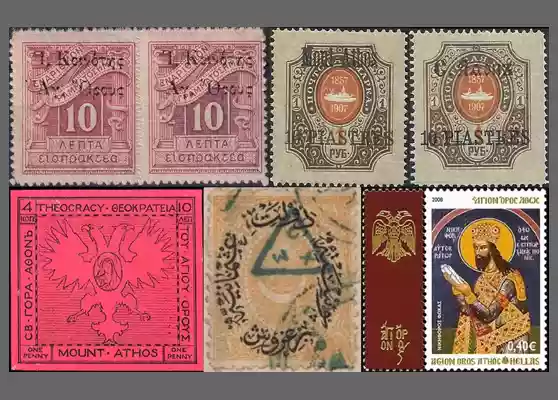
Article from the field of postage stamp territories focused on the history and postal service of the Mount Athos peninsula.
Athos is an autonomous monastic republic situated on the easternmost peninsula of Chalkidiki in Greece. It is approximately 50 km long, 8 to 12 km wide and covers an area of 336 km2.
There are 20 Orthodox monasteries here; the parliament and administrative council (government) have their seat in the capital, Karyes (Καρυές). Women are prohibited from entering the territory of the republic.
In antiquity, the name Athos referred only to the mountain, while the peninsula was called Akté. Today, both the mountain and the peninsula bear the name Athos; it is also known as Chersonisos Athos (Athos Peninsula), in Greek as Agion Oros (Holy Mountain), in Turkish as Aynaros, Aynoros or Ayion Oros, and in French as Mont Athos.
Hermits had been active here since the 9th century. In 963, the first monastery, called the “Great Lavra” (Megisti Lavra), was founded. Following the fall of the Byzantine Empire, Athos was under Ottoman rule from 1430 until 1912, when it was annexed to Greece.
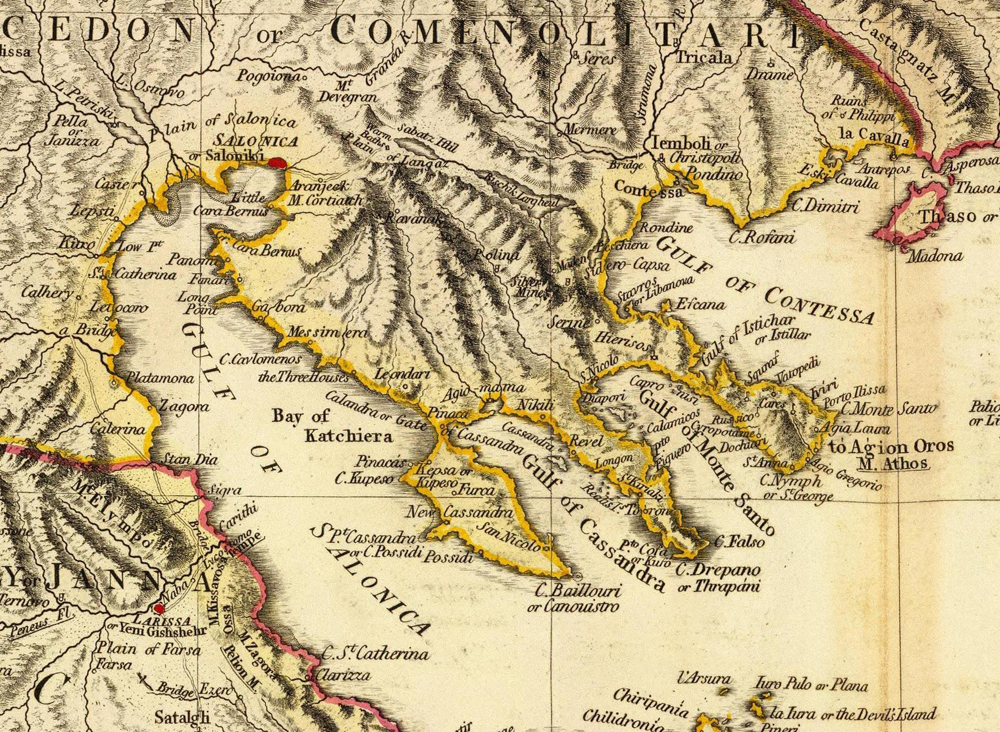
Map of the Chalkidiki peninsula from 1791.
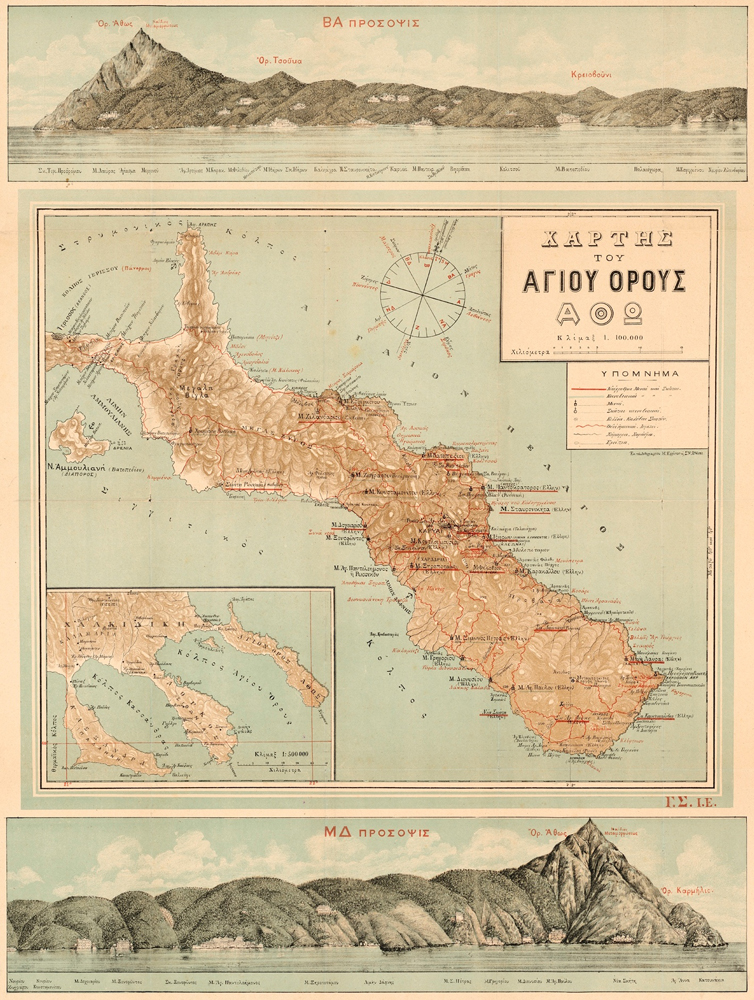
Map of the Athos peninsula.

Mount Athos, with an elevation of 2,033 metres.
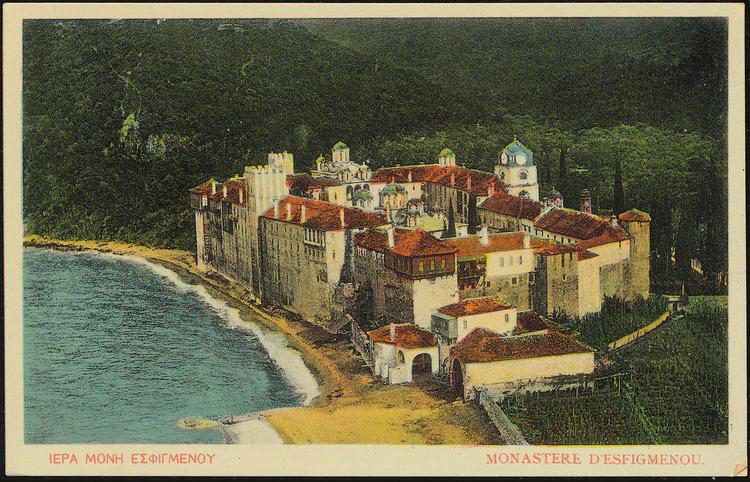
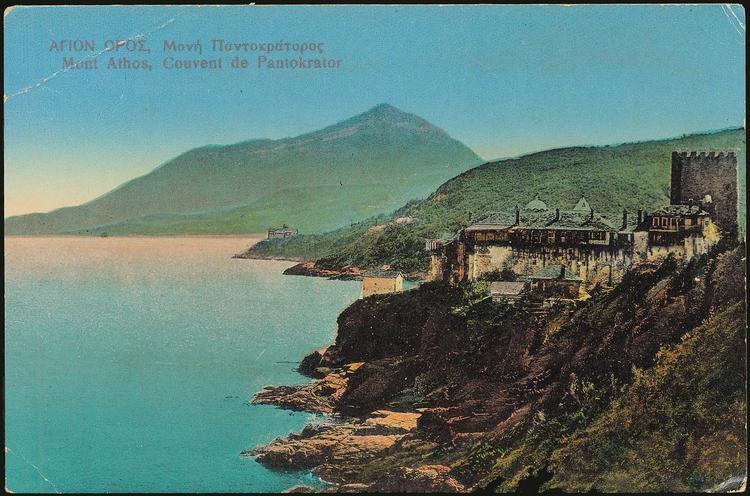
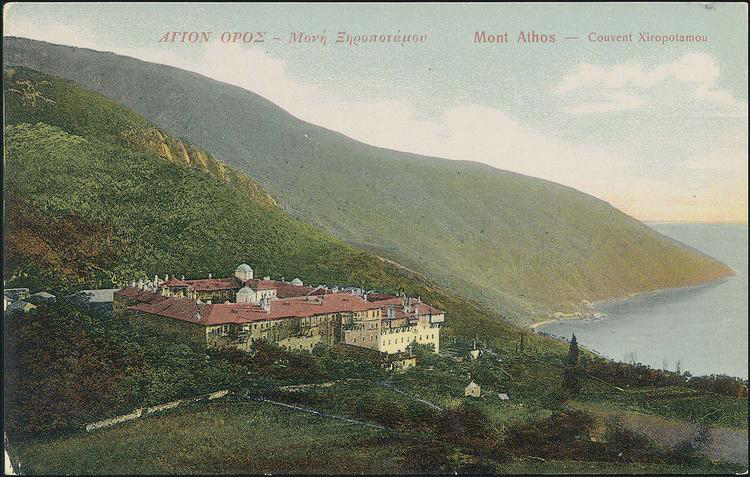
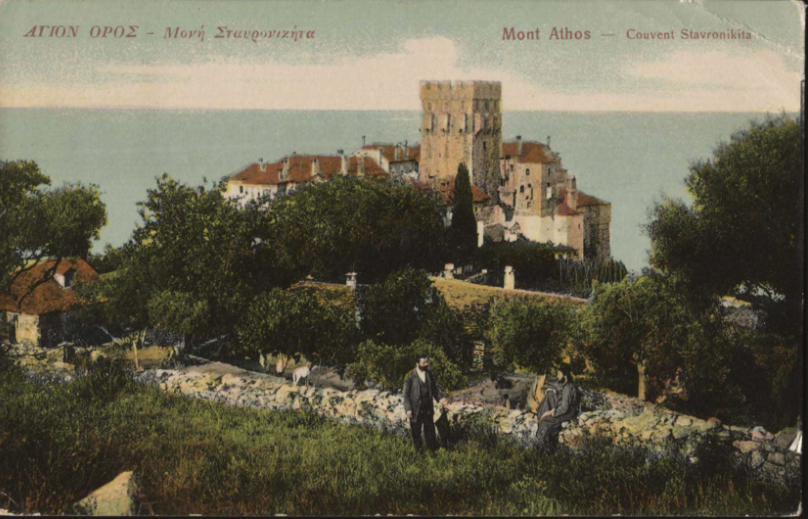
Postcards depicting several monasteries.
After its incorporation into the Ottoman Empire, Athos belonged to the Salonica Vilayet. As in other regions of the Empire, there was no civil postal service on the peninsula until the middle of the 19th century. Letters abroad were usually sent privately through captains and crews of ships calling at the ports. The monks distributed envelopes bearing their address to various places in Russia, asking the faithful to return them with the necessary financial support for the monks.
The poor development of local postal services led to the need for an Ottoman postal service with a network of its own foreign post offices to provide regular communication with other countries.
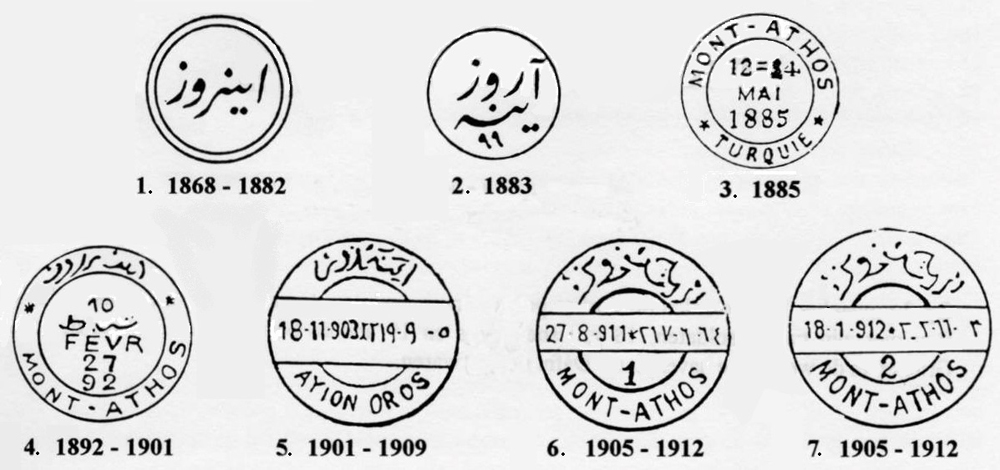
On Athos, ordinary Ottoman stamps were used for postage; between 1868 and 1882, they were cancelled with a double single-circle postmark (No. 1) bearing the Arabic-script inscription AYNAROS (AYNOROS or AYON-OROS = Holy Mountain).
In 1883, a single-circle postmark was used (No. 2).
From 1885, a new bilingual postmark (No. 3) was introduced, inscribed “MONT - ATHOS” at the top and “TURQUIE” at the bottom. As far as is known, it is the only postmark bearing two dates, one according to the Gregorian calendar and the other according to the Julian calendar, which differed by 12 days before 1900.
In 1892, the earlier postmarks were replaced by bilingual ones with Arabic script at the top and the inscription “MONT - ATHOS” (later AYION OROS) at the bottom (No. 4). From 1901, the postmark was divided in the centre by a continuous date bridge (Nos. 5–7).
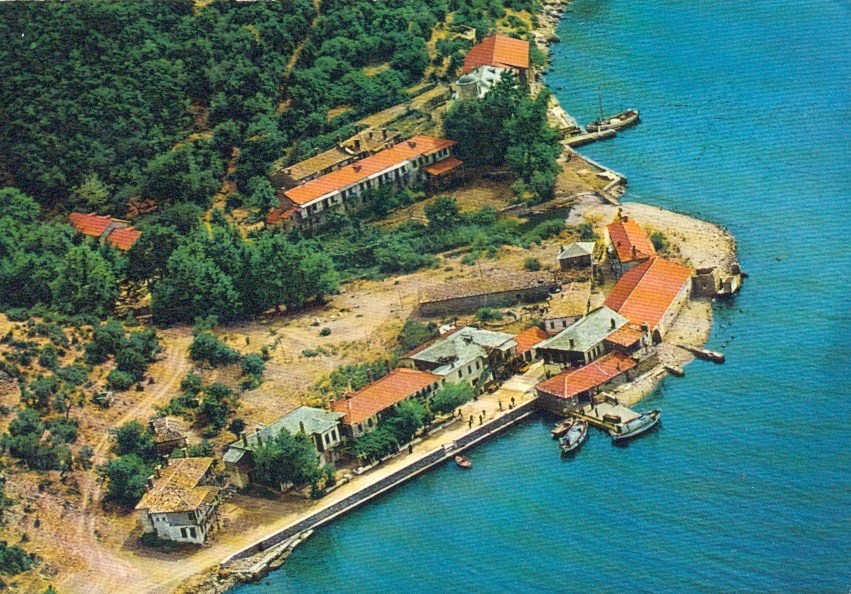
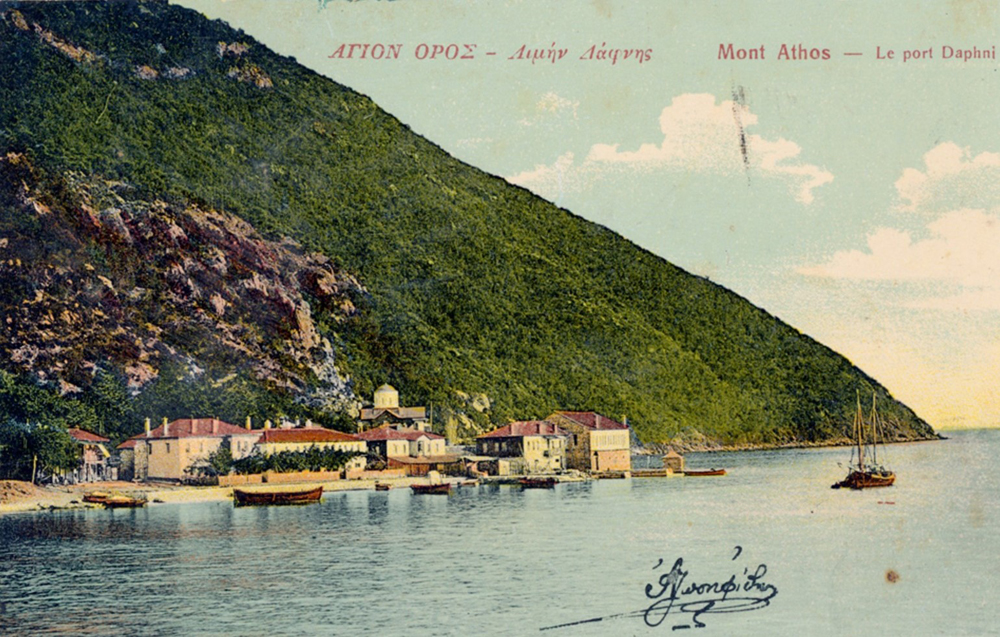
The port of Dafni.
Another Ottoman post office was located in the port of Dafni.
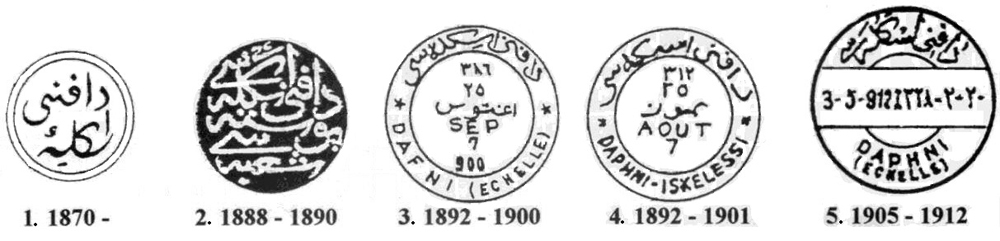
From 1870, double single-circle postmarks with Arabic-script inscriptions in the centre were used (No. 1).
The second type was a single-circle negative postmark, likewise bearing only Arabic script (No. 2), used from 1888 to 1890.
From 1892 to 1904, double-circle bilingual postmarks were used, with Arabic script at the top and Latin script at the bottom (Nos. 3 and 4).
Finally, in 1905, a postmark divided in the centre by a continuous date bridge was introduced here as well (No. 5).
Since Ottoman stamps had to be bought with gold liras, people began smuggling to Athos stamps purchased with much cheaper paper liras in Constantinople. This made stamps unsaleable at the local post office.
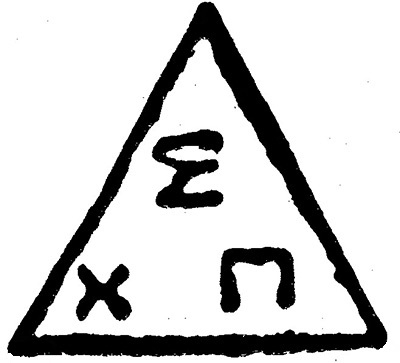
To prevent this smuggling, stamp stocks were hand-overprinted in 1880 with a small triangle bearing the initials Σ Χ Π of the local postmaster, Sotirios Chatzi Petropoulos (Σωτήρης Χατζη Πετρόπουλος).
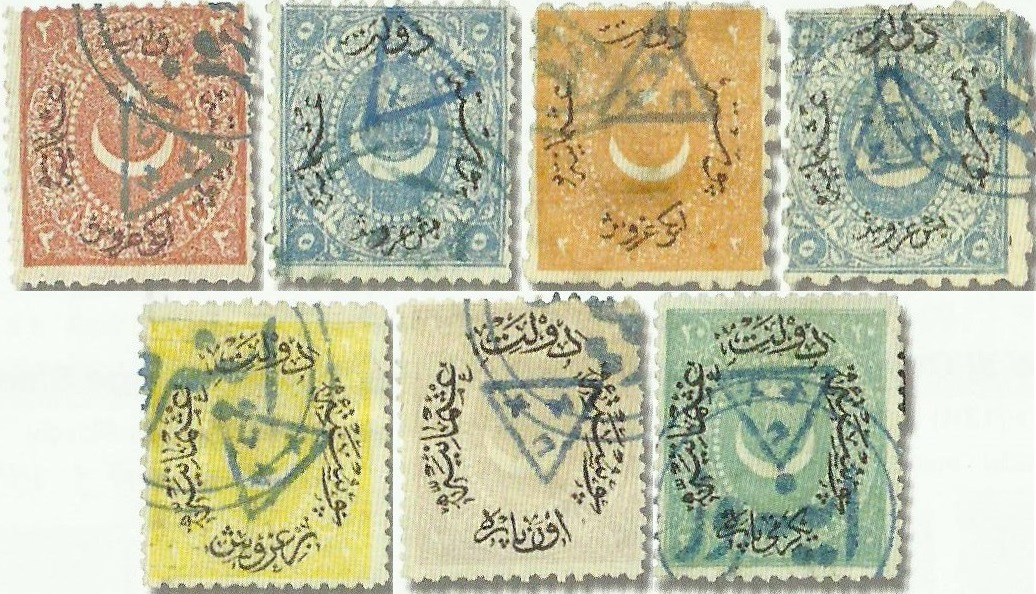
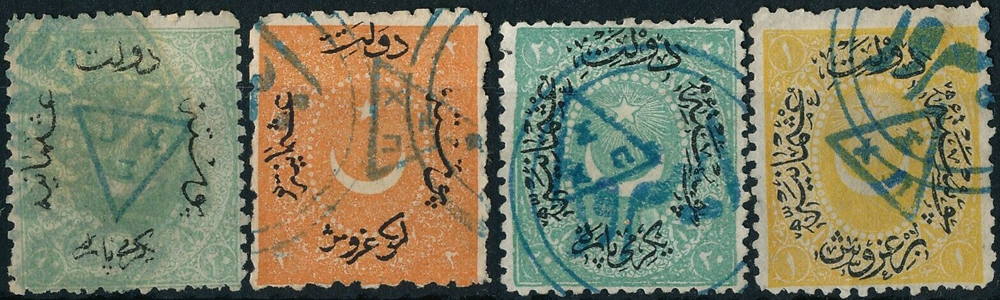
In 1881, a monetary reform took place in the Ottoman Empire, declaring the gold lira to be the sole legal tender under the “Gold Standard”, in which the economic unit of account is based on a fixed quantity of gold. Stamp smuggling lost its importance, and ordinary stamps without overprints were introduced for postage.
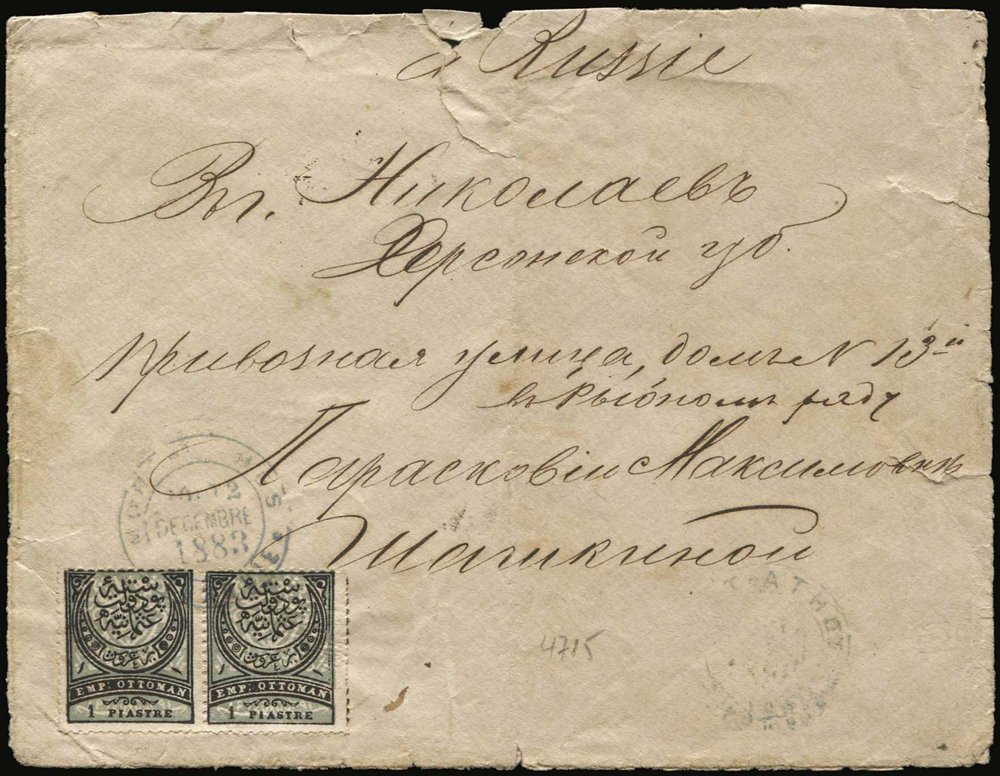
Letter sent on 12 December 1883 from Mount Athos to Nikolaev, Russia.
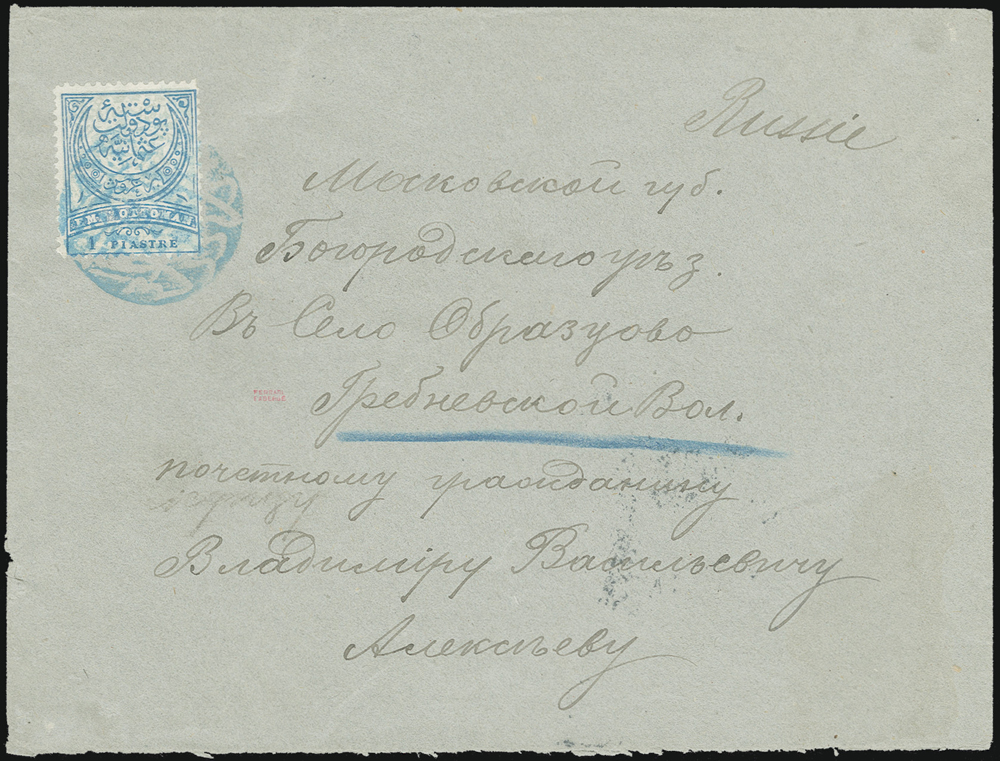
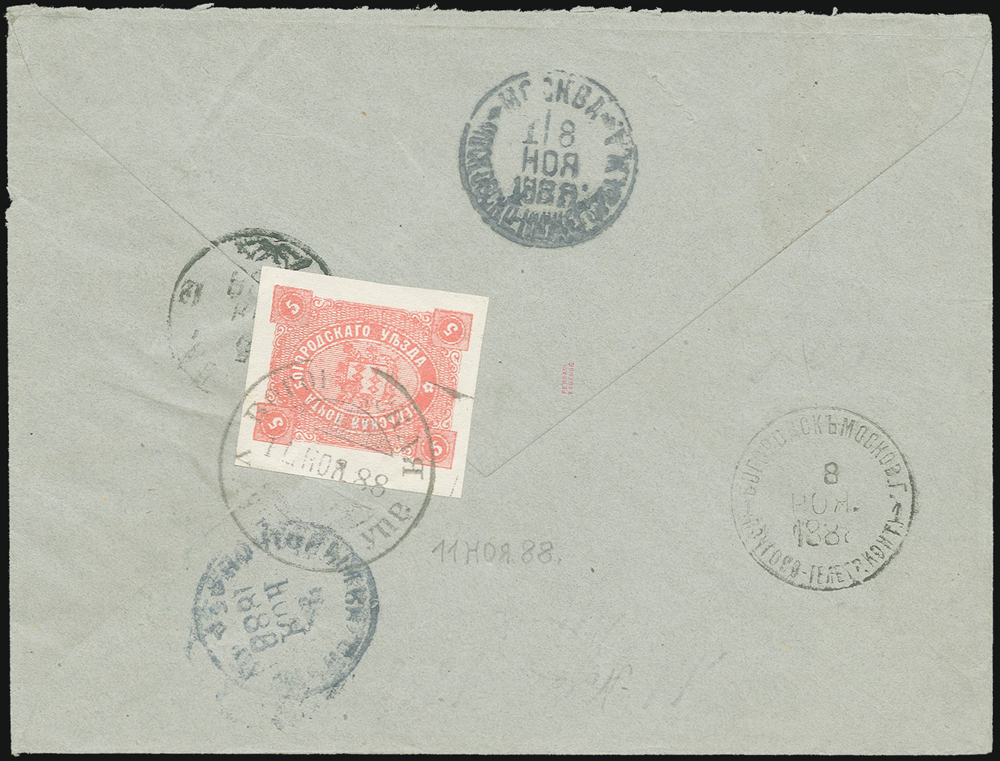
Letter sent in early November 1888 from Dafni to the Bogorodsk district,
with a transit postmark from Odessa dated 5 November 1888 on the reverse,
two transit postmarks from Moscow dated 8 November,
and additionally franked with a Bogorodsk Zemstvo stamp dated 11 November 1888.
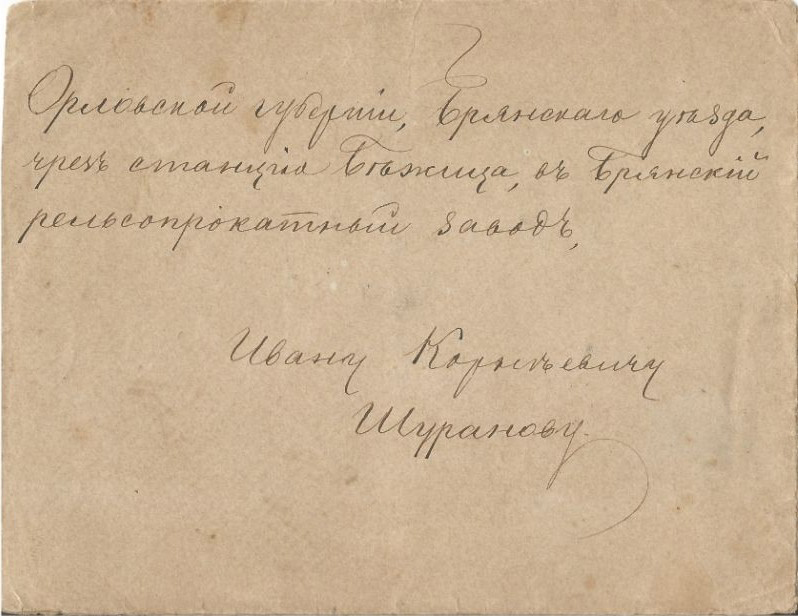
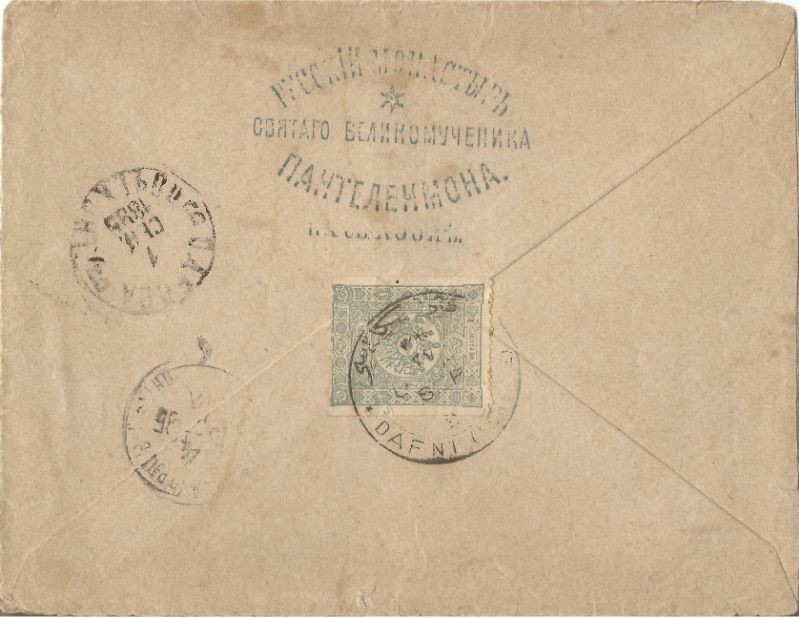
Letter sent on 1 September 1895 from Dafni to Briansk (Брянск) in the Oryol Governorate,
with a blue oval cachet on the reverse:
РУССКІЙ MOHACTЫPЬ CBЯTAГO BEЛИKOMУЧEHИKA ПAHTEЛИMOHA HA CB. АФOHЪ,
transit postmark ОДЕССА 1 CEH 1895
and arrival postmark БPЯHCK OPЛOB 4 IX 1895.
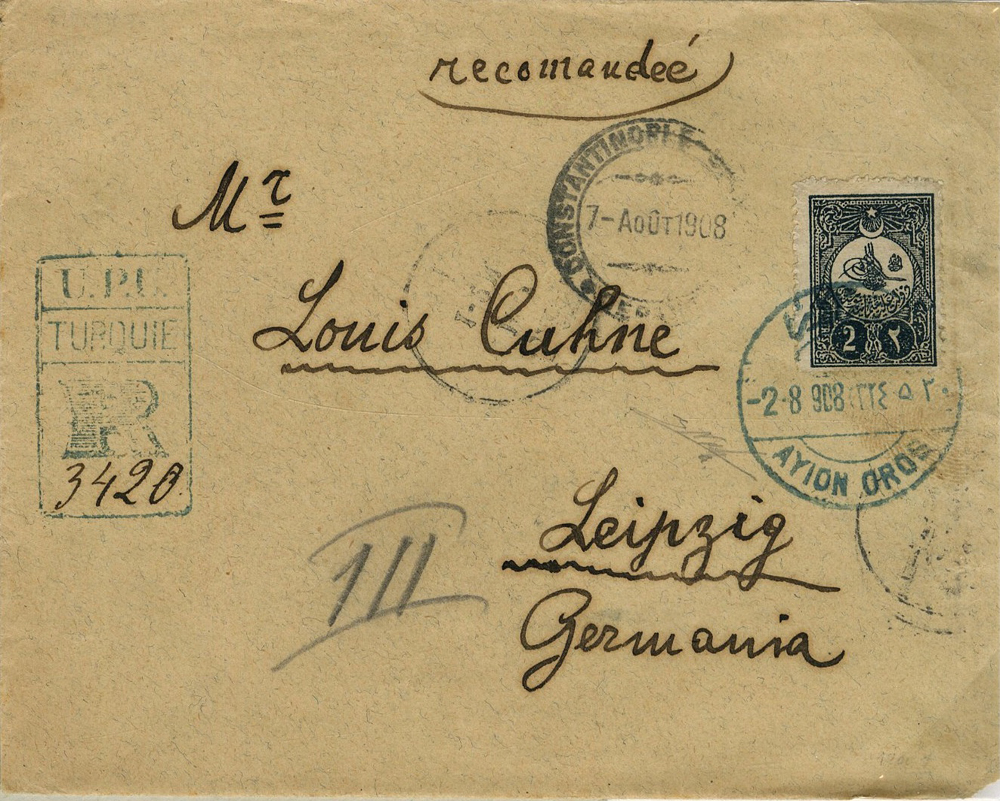
Registered letter sent on 2 August 1908 to Leipzig, Germany,
with a transit postmark from Constantinople dated 7 August.
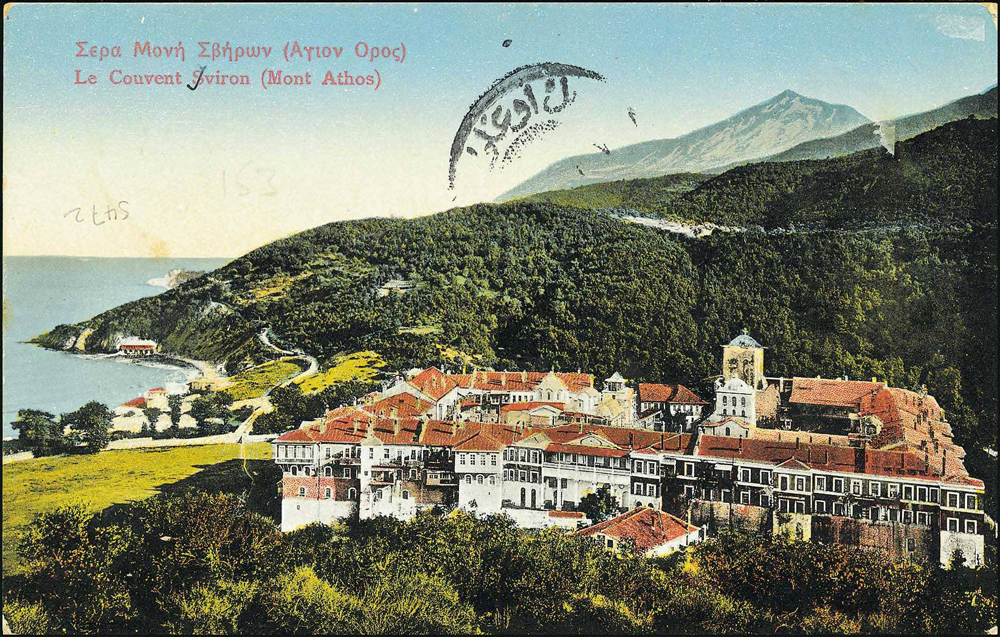
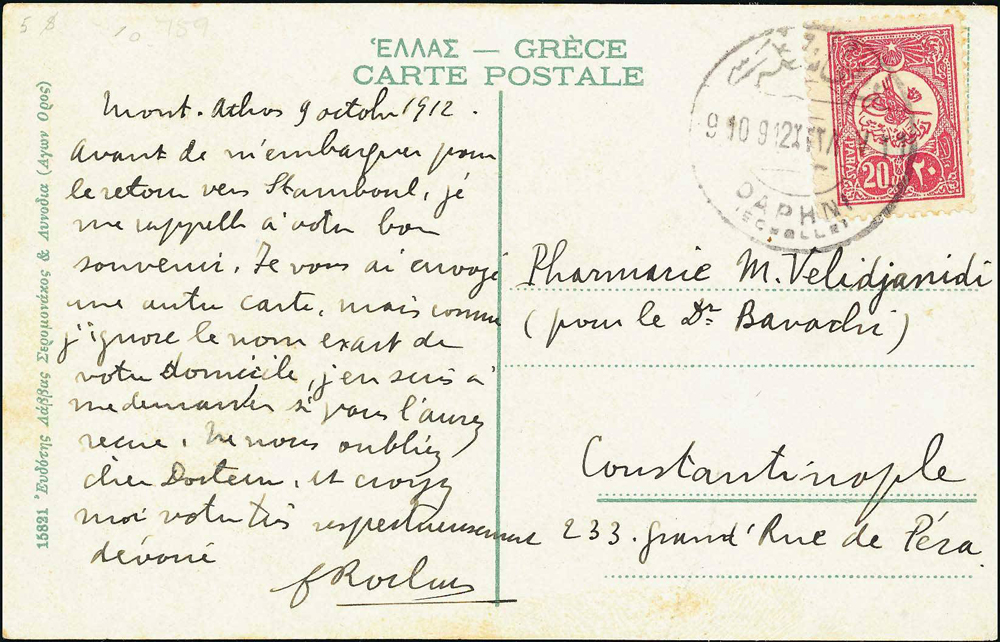
Postcard sent on 9 October 1912 from the port of Dafni to Constantinople.
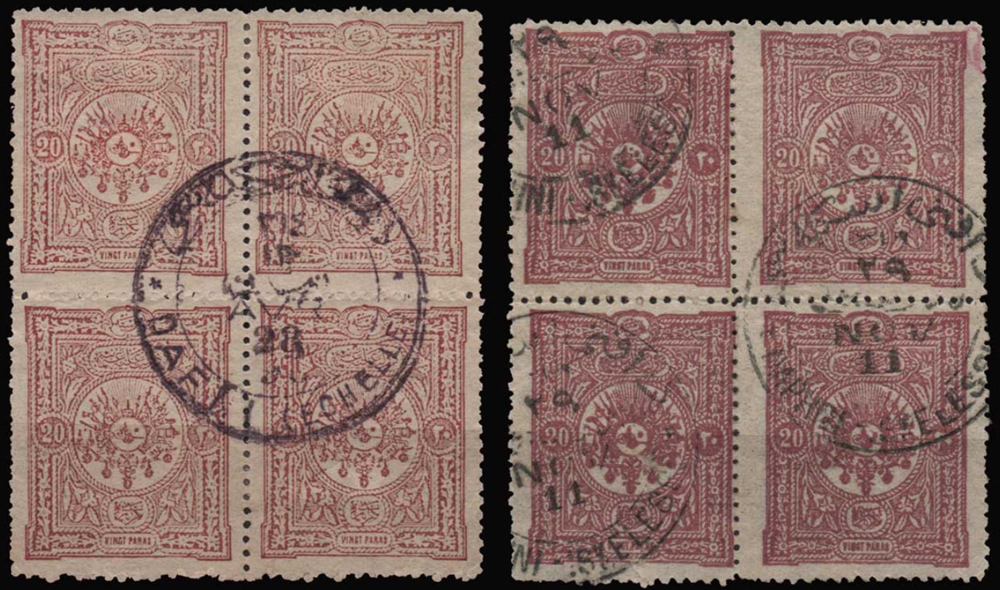
DAFNI (ECHELLE) and DAFNI-ISKELESI postmarks.
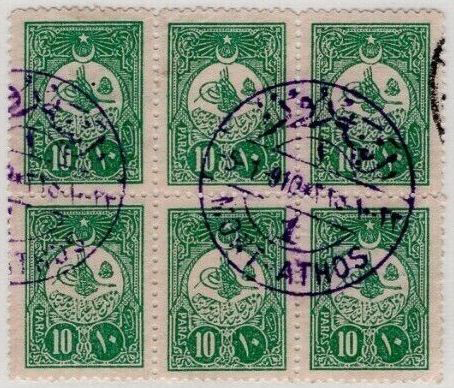
MONT-ATHOS postmark.
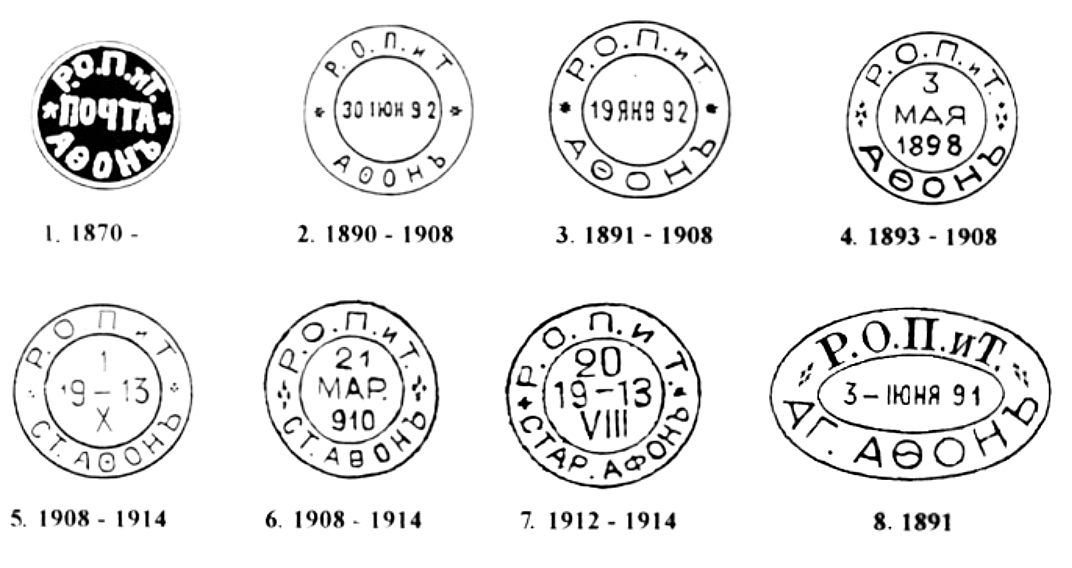
In 1870, the Russian Steam Navigation and Trading Company (Р.О.П.и.Т. – ROPiT) established a branch of the Russian Post in the Ottoman Empire at Karyes, and a few years later opened another one in the port of Dafni. However, its ships had carried mail for several years before the Russian post office was opened. The company was in fact an important instrument of Russian policy in the Aegean Sea and was present wherever Russian interests existed.
Standard ROPiT postage stamps bearing the inscription „ВОСТОЧНАЯ КОРРЕСПОНДЕНЦІЯ“ were used for postage.
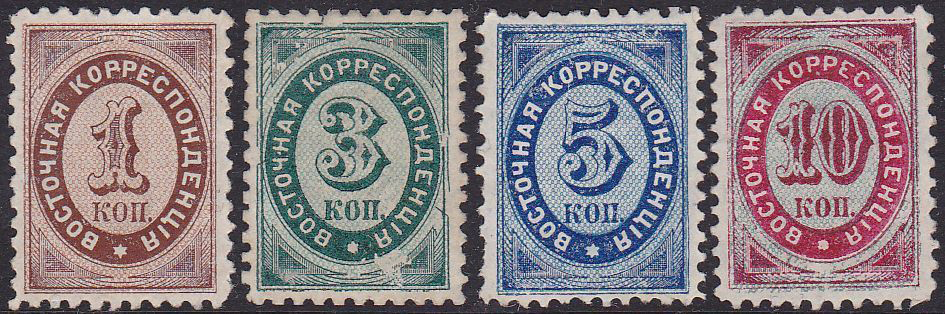
Initially, mail was cancelled with a negative postmark bearing the inscription Р.О.П.и.Т. / ПОЧТА / АФОНЬ (No. 1).
Regular postal operations were established in 1890, using standard-type Russian Levant postmarks. From 1890 to 1908, this was a double-circle postmark, 26 mm in diameter, bearing the inscription Р.О.П.и.Т. / АФОНЬ (No. 2).
A similar but slightly larger postmark, 27 mm in diameter and with larger lettering, was used from 1891 to 1908 (No. 3).
Later, from 1893 to 1908, a partially modified version with the date in three lines was used (No. 4).
As confusion arose with a town of the same name, Athos, in the Caucasus, the branch on the peninsula was renamed Old Athos in 1908 and the use of the earlier postmarks ended.
From 1908 to 1914, postmarks bearing the inscription Р.О.П.и.Т. / СТ. АФОНЬ were used, with two forms of date display (Nos. 5 and 6).
In the subsequent period, from 1912 to 1914, the inscription was changed to Р.О.П.и.Т. / СТАР. АФОНЬ (No. 7).
In 1891, a special oval postmark for documents bearing the inscription Р.О.П.и.Т. / АГ. АФОНЬ was used (No. 8).
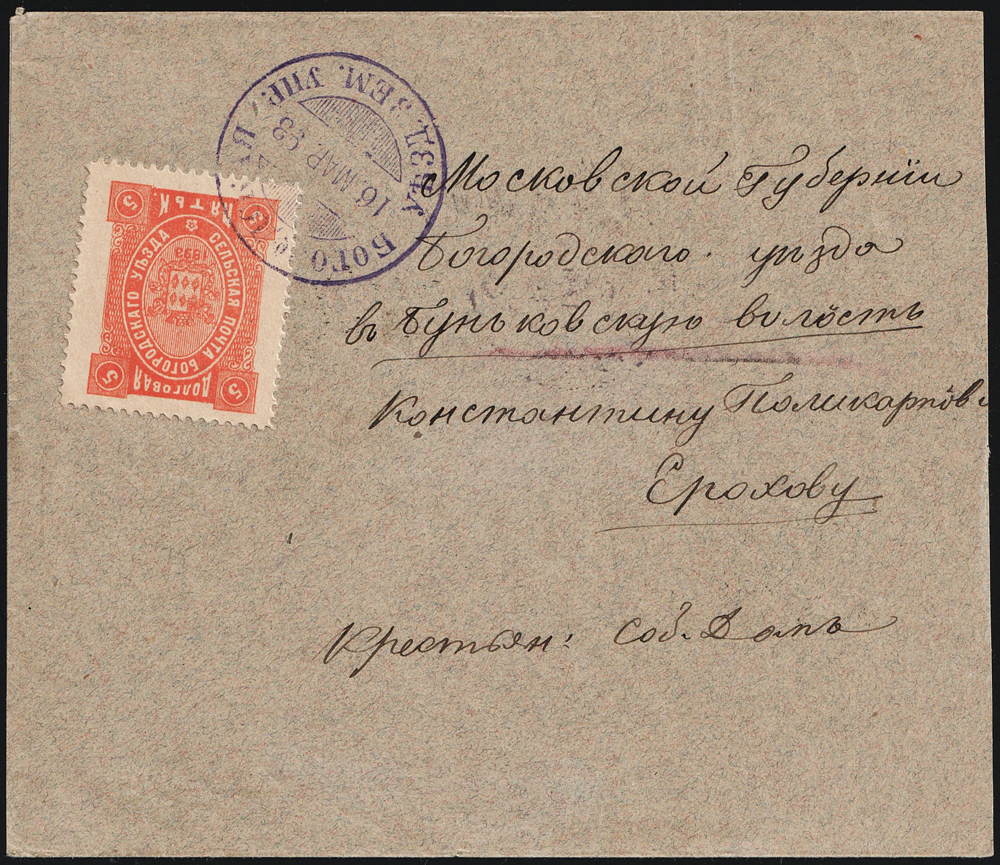
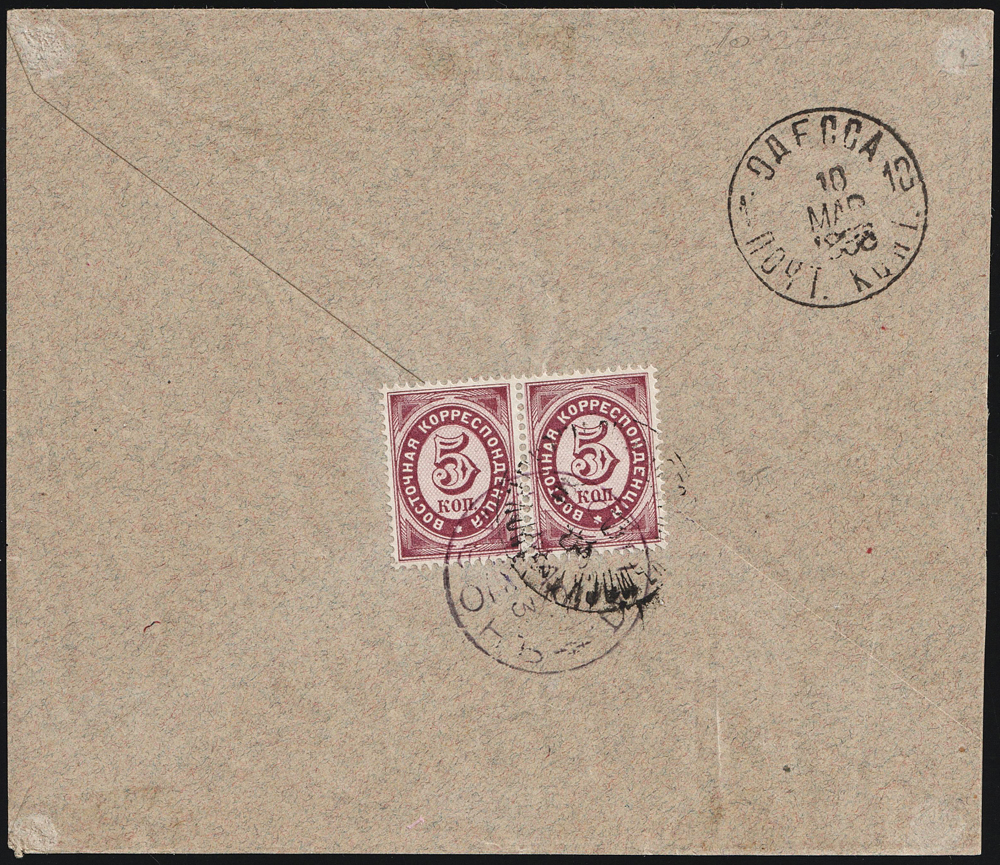
Letter sent on 3 March 1893 from Mount Athos to Bunkovo (Буньково) in the Moscow Governorate,
with a transit postmark from Odessa dated 10 March 1893 on the reverse,
and additionally franked with a Bogorodsk Zemstvo stamp postmarked 16 March 1893.
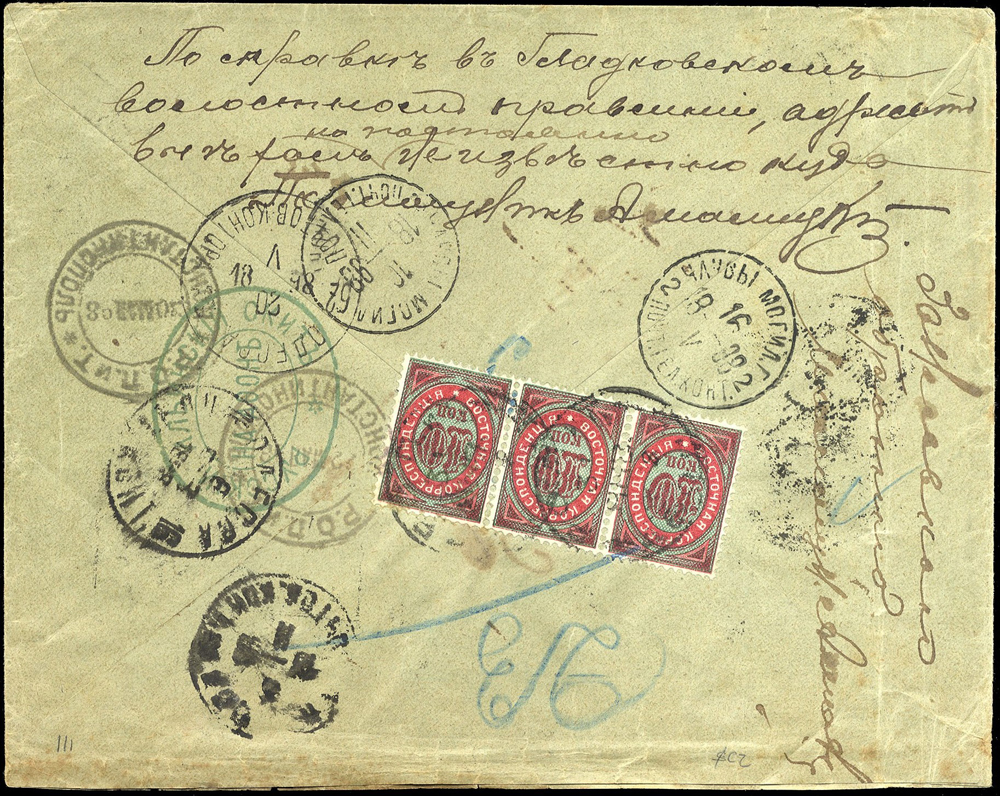
Letter sent on 31 January 1898 from Mount Athos to Chausy (Чаусы) in the Bryansk Governorate,
with a green oval cachet РУССКІЙ ИЛЬИНСКІЙ СКИТЪ НА АФОНЪ,
transit postmark ОДЕССА 6 ФЕВ 1898
and arrival postmark ЧАУСЫ МОГИЛ. Г 10 II 1898.
The letter was returned to the sender in May, as it bears further postmarks with later dates:
postmark ЧАУСЫ МОГИЛ. Г 16 V 1898,
transit postmark ОДЕССА 20 V 1898,
transit postmark КОНСТАНТИНОПОЛЬ 22 MAЯ 98
and transit postmark КОНСТАНТИНОПОЛЬ 30 MAЯ 98.
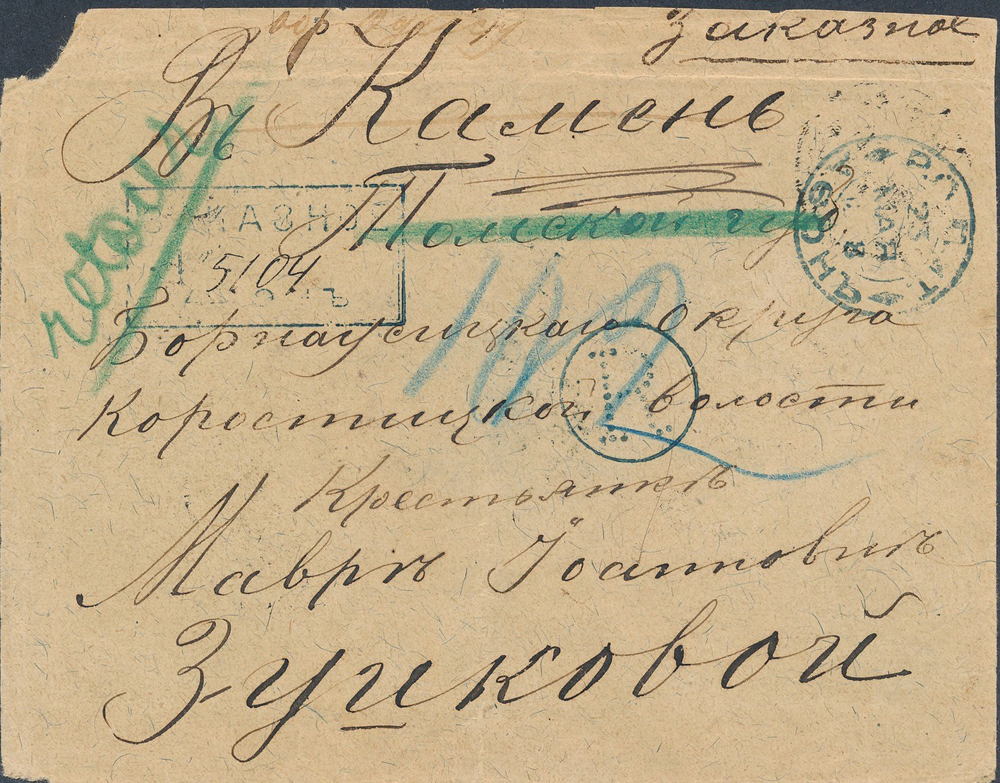
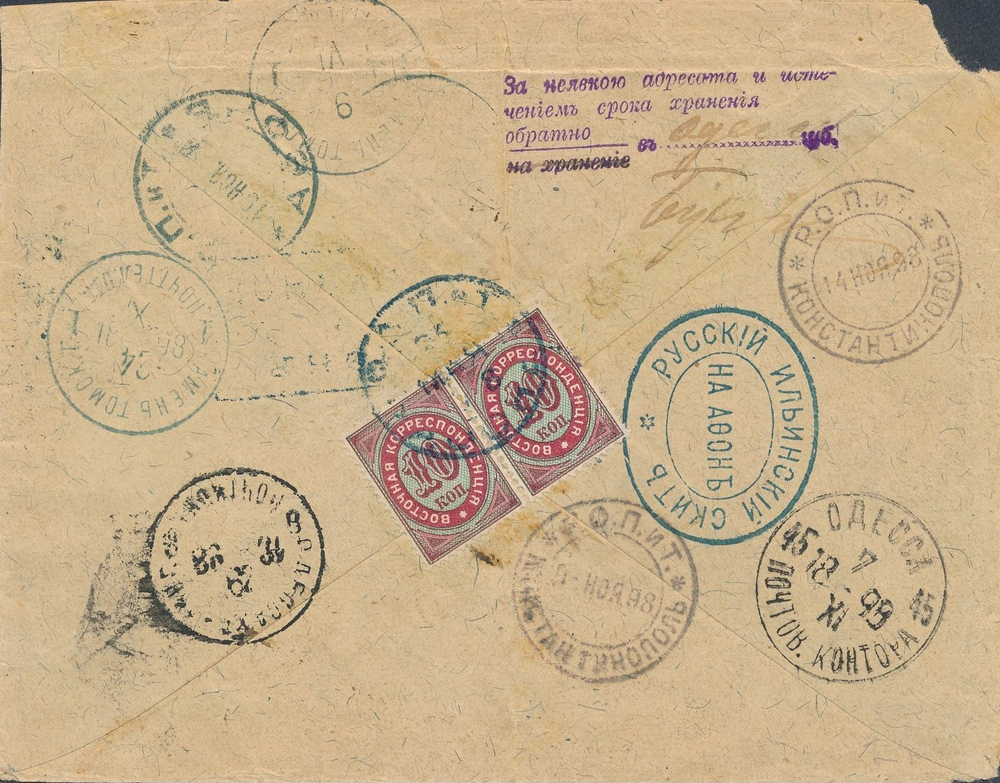
Registered letter sent on 23 May 1898 from Mount Athos to Kamen (Kaмeнь) in the Tomsk Governorate,
with a blue oval cachet РУССКІЙ ИЛЬИНСКІЙ СКИТЪ НА АФОНЪ,
transit postmark ОДЕССА 29 V 1898,
arrival postmark KAMEHЬ TOMCK. Г. 9 VI 1898.
It was returned to the sender in October: postmark KAMEHЬ TOMCK. Г. 24. X. 1898,
transit postmark ОДЕССА 7 XI 1898,
transit postmark КОНСТАНТИНОПОЛЬ 9 HOЯ 98,
transit postmark КОНСТАНТИНОПОЛЬ 14 HOЯ 98
and arrival postmark АФОНЪ 15 HOЯ 98.
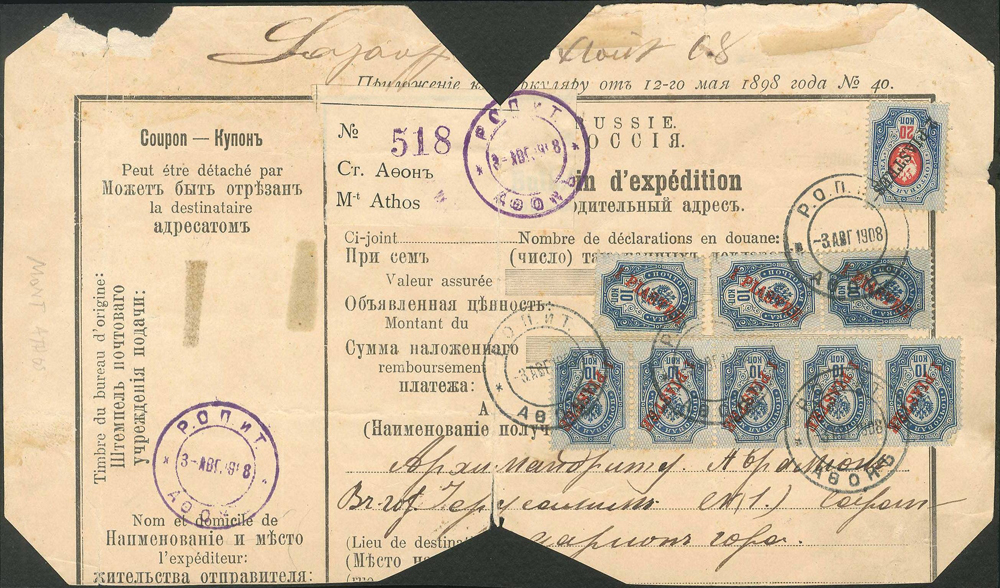
Postal parcel card for an insured parcel sent from Mount Athos on 3 August 1908.
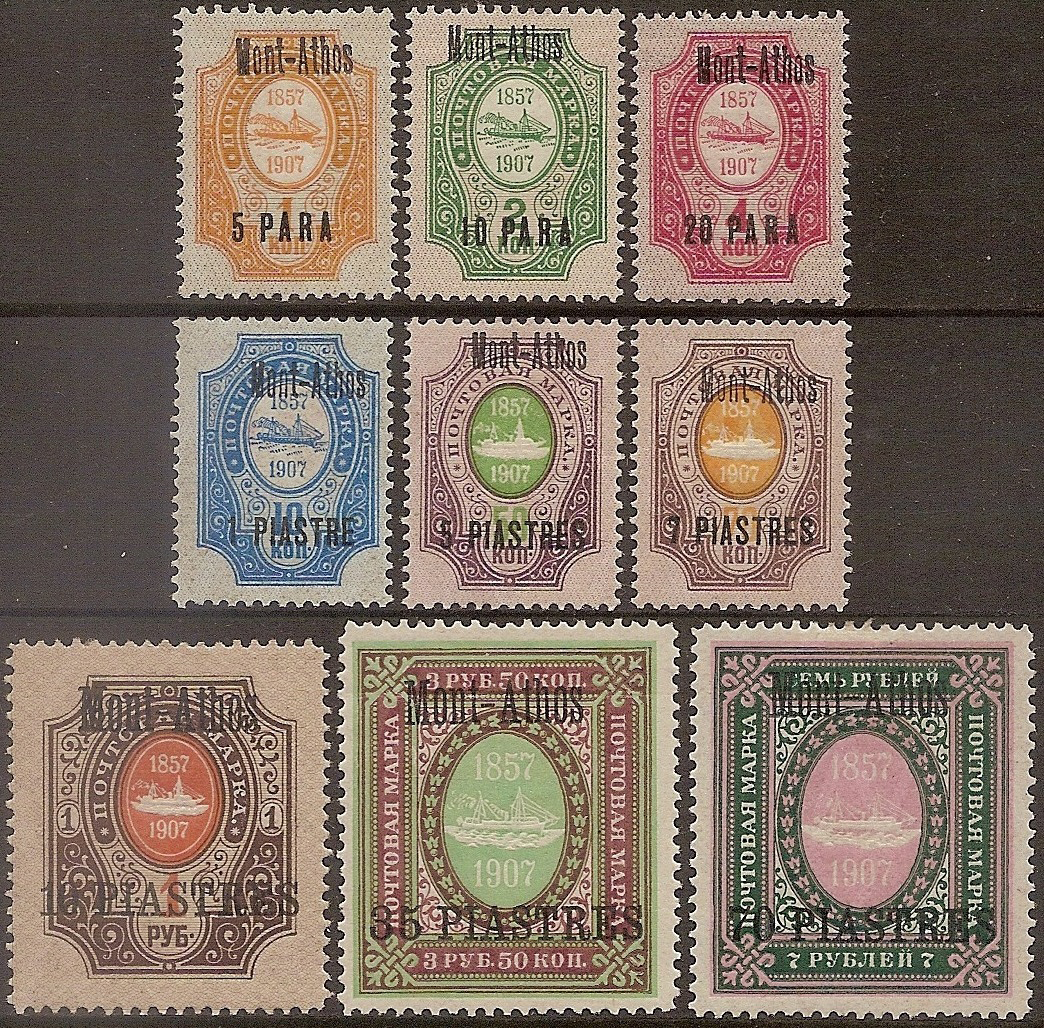
To commemorate its 50th anniversary, ROPiT issued a series of nine commemorative postage stamps on 10 May 1909. Their design was similar to that of Imperial Russian stamps, but a steamship was depicted in the centre instead of the state emblem, together with the anniversary dates; they were overprinted in black with denominations in paras or piastres.
After several months of use, it was decided to issue further commemorative sets for the 12 principal post offices, overprinted with their names in French.
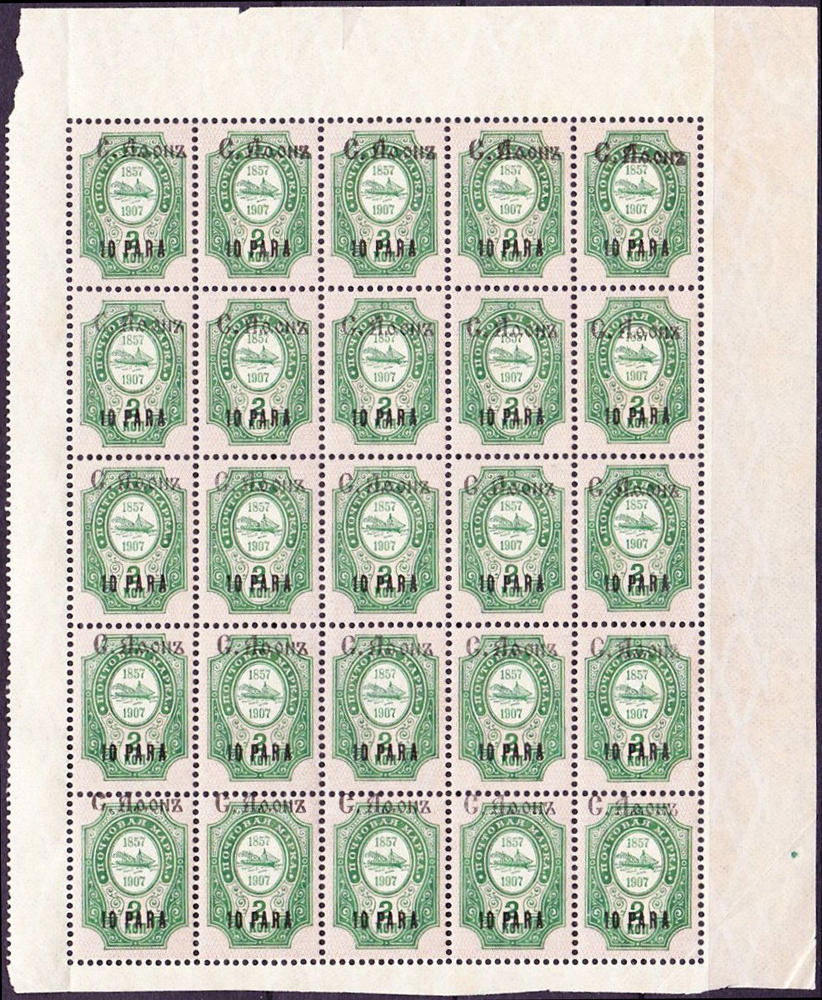
In November 1909, nine stamps inscribed “Mont-Athos” were issued.
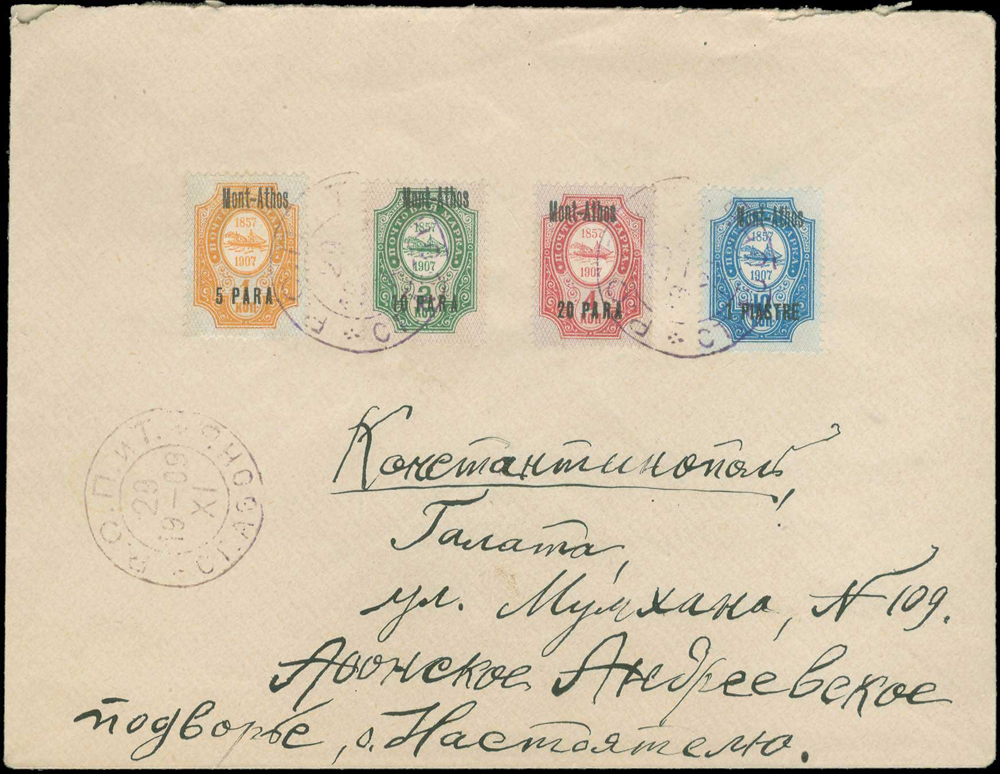
Letter sent on 29 November 1909 from Mount Athos to Constantinople.
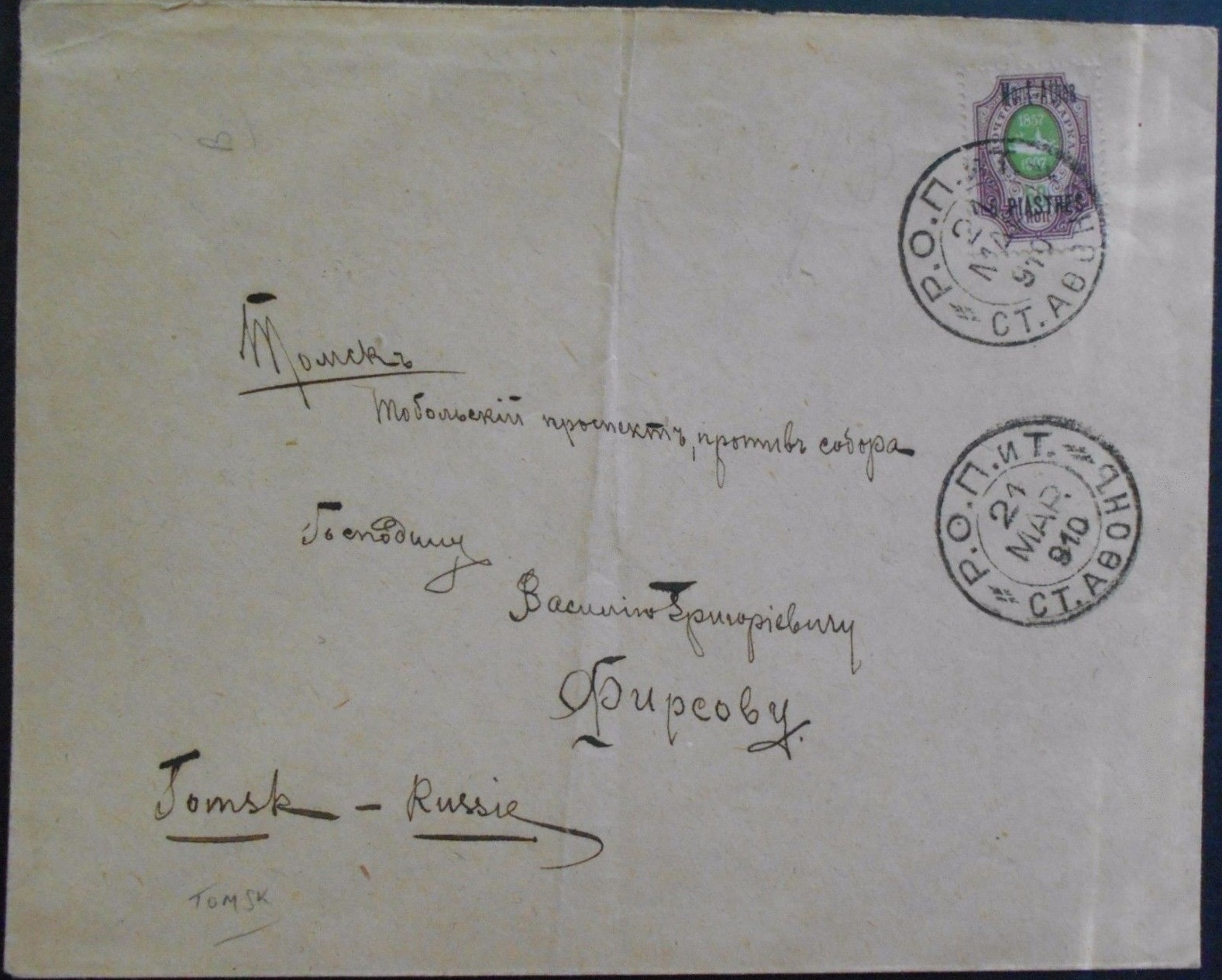
Letter sent on 21 March 1910 from Mount Athos to Tomsk.
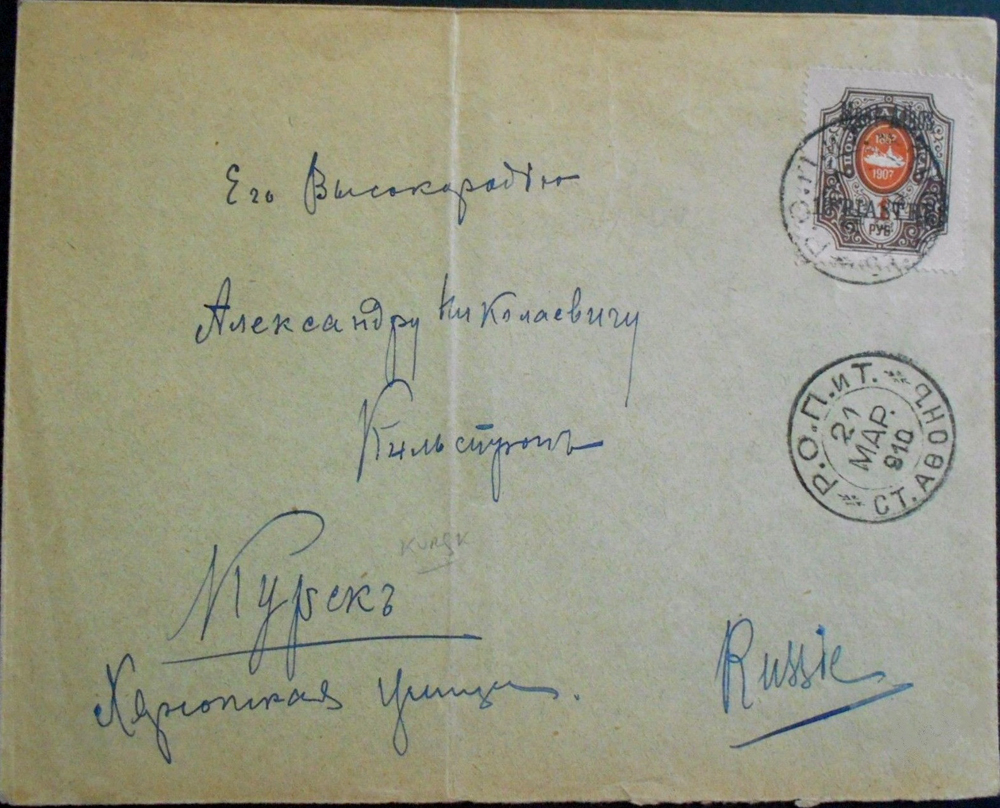
Letter sent on 21 March 1910 from Mount Athos to Kursk.
On 30 August 1910, another seven stamps were issued, now with the altered Cyrillic inscription “С.Афонь”. The С stood in Russian for “Старый – Old”, to avoid confusion with the town of Athos in the Caucasus.
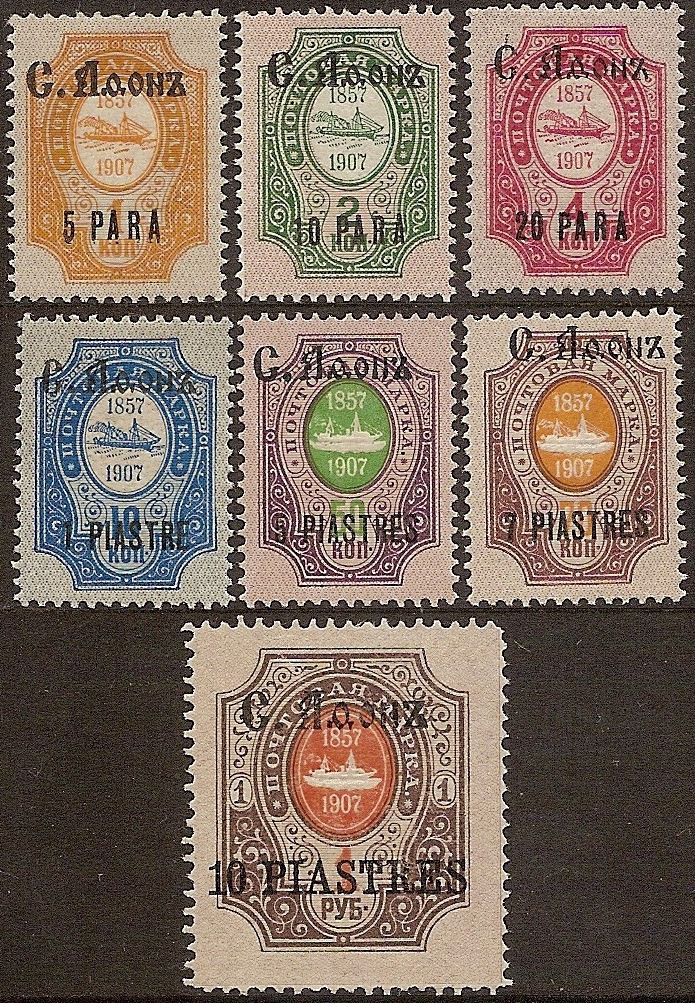
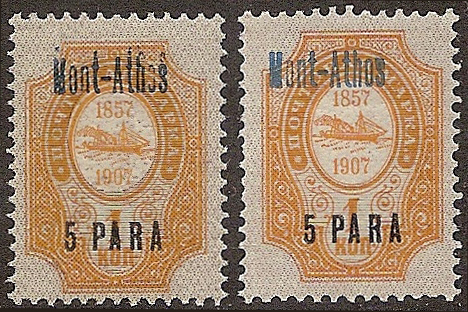
On 22 September 1910, a reprint was made: the yellow stamp with the lowest denomination of 5 paras was overprinted in blue with the same Latin-script inscription as the first issue. It occurs in two shades, dark blue and light blue.
In 1911, all commemorative stamps were withdrawn from circulation and replaced by Russian stamps overprinted in paras or piastres.
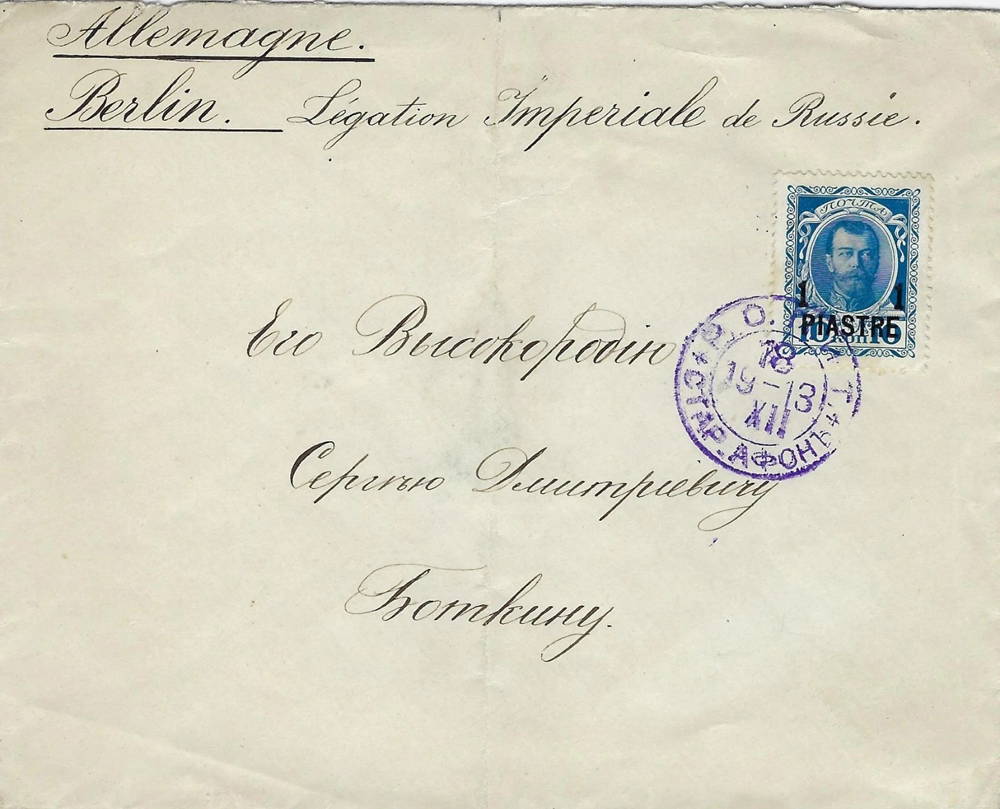
Letter sent on 18 December 1913 from Mount Athos to Berlin.
The Russian post office was officially closed in 1913–14 after Greece occupied the Chalkidiki peninsula during the First Balkan War. Unofficially, however, it continued operating at least until the end of 1917.
The Balkan League was a military and political alliance of Bulgaria, Serbia, Greece and Montenegro, established during 1912 and directed against the Ottoman Empire. On 8 October 1912, the League declared war on the Empire in order to conquer its Balkan territories.
The Greeks landed at Dafni on Athos on 2 November and the Ottoman garrison surrendered immediately. On the same day, a Greek naval detachment took over the postal service, using postmarks inscribed ΝΑΥΤΙΚΟ ΑΓΗΜΑ (Naval Forces).
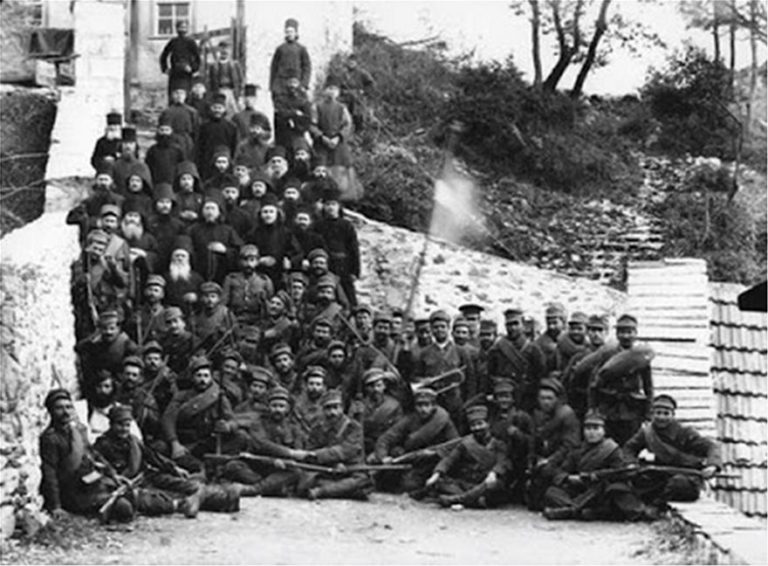
Greek soldiers photographed with monks in Karyes.
At the end of 1912, two Greek post offices were opened. At Karyes, postmarks inscribed ΑΓΙΟΝ ΟΡΟΣ, later ΚΑΡΥΑΙ, were used; at Dafni, postmarks bore the inscription ΔΑΦΝΗ.
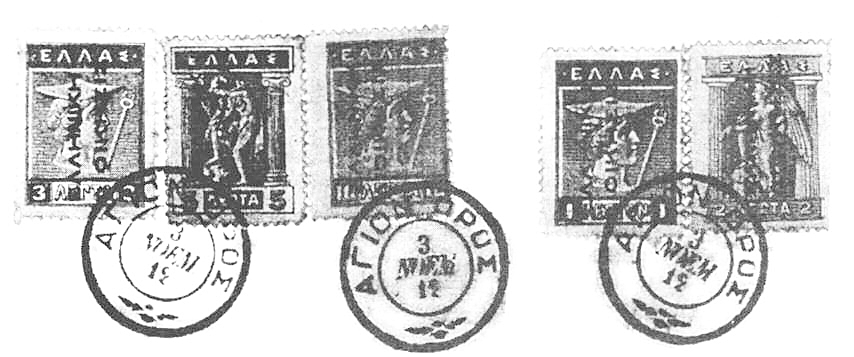
At first, these post offices, like all the others in the conquered territories, used Greek stamps overprinted ΕΛΛΗΝΙΚΗ ΔΙΟΙΚΗΣΙΣ, and later definitive stamps bearing the text ΕΚΣΤΡΑΤΕΙΑ 1912 (Campaign issue).
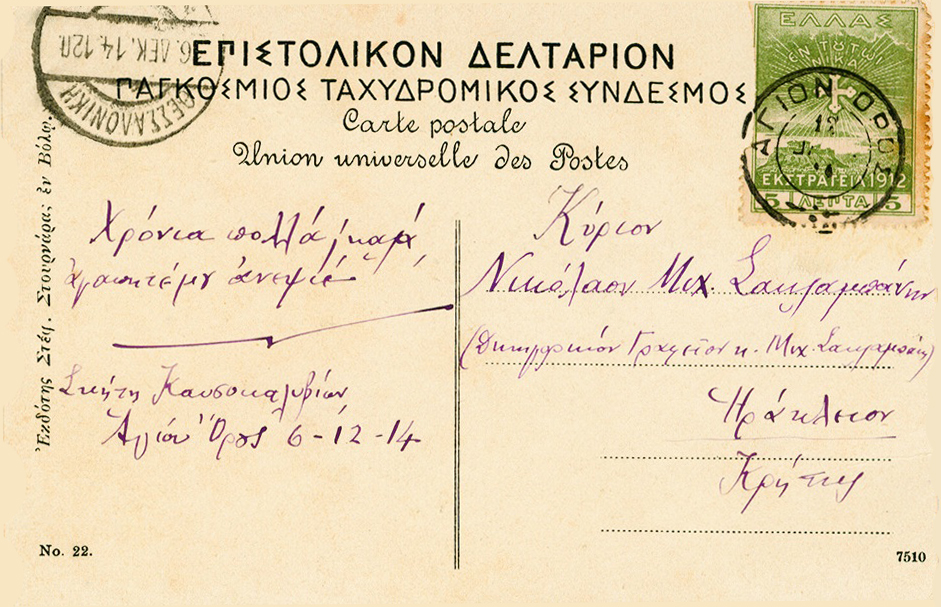
Postcard sent to Heraklion, Crete, on 6 December 1914,
with transit postmark from Salonica ΘEΣΣΑΛOΝΙΚΗ 16. ΔEK 14.
During the First World War, in the winter of 1915–16, the Entente countries considered the preventive occupation of Mount Athos in order to protect the eastern flank of Allied forces stationed at Salonica. The leadership of the British Royal Navy suspected that it could serve as a base for enemy submarines of the Kaiserliche Marine. Another objective was to grant Athos independence. HMS Ark Royal, the first ship designed and built as a seaplane carrier, was prepared for combat operations.
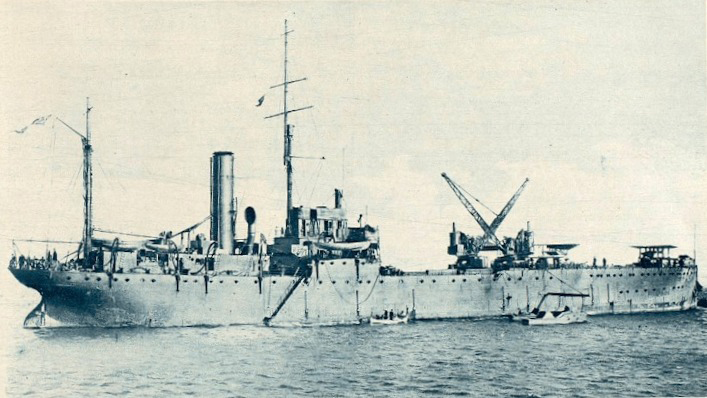
HMS Ark Royal
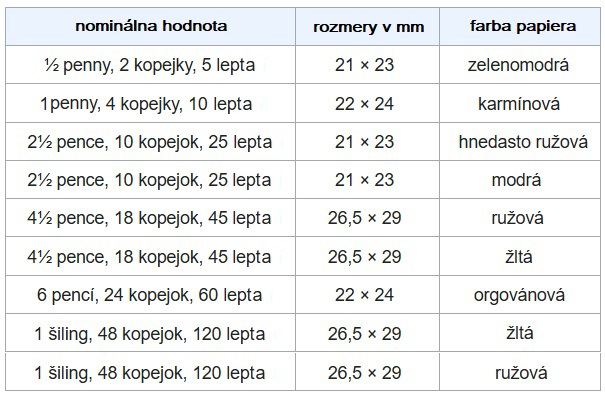
As part of preparations for an Allied invasion, a series of stamps was produced on board the ship to meet the postal needs of the monastic community. Its release was planned for 25 January 1916.
The square stamps were printed in black ink on paper of various colours in sheets of 3 x 4, without perforation, in six denominations and three currencies: British pence or shillings, Russian kopecks and Greek lepta. All stamps of the issue had the same design: a double-headed Byzantine eagle with the Madonna and Child in an oval medallion on its breast. The inscriptions around the edge read CB ΓΟΡΑ АФОNЬ – THEOCRACY – ΘΕΟΚΡΑΤΕΙΑ – ΤΟΥ ΑΓΙΟΥ ΟΡΟΥΣ - MOUNT ATHOS.
The series was initiated by several naval officers led by Lieutenant Harry Pirie-Gordon and was produced at their own expense.
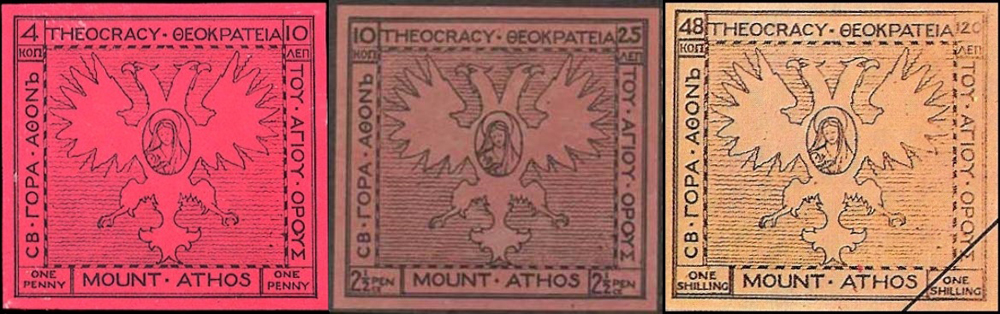
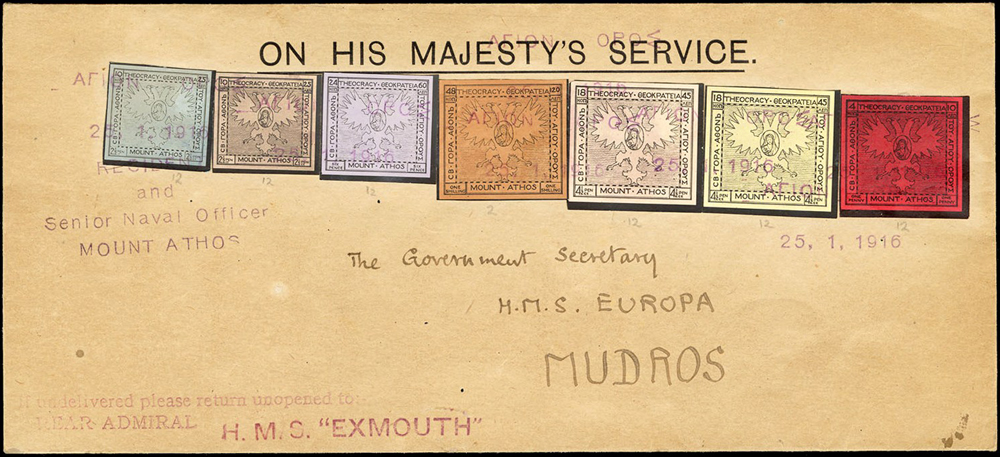
Letter sent to Mudros on 25 January 1916.
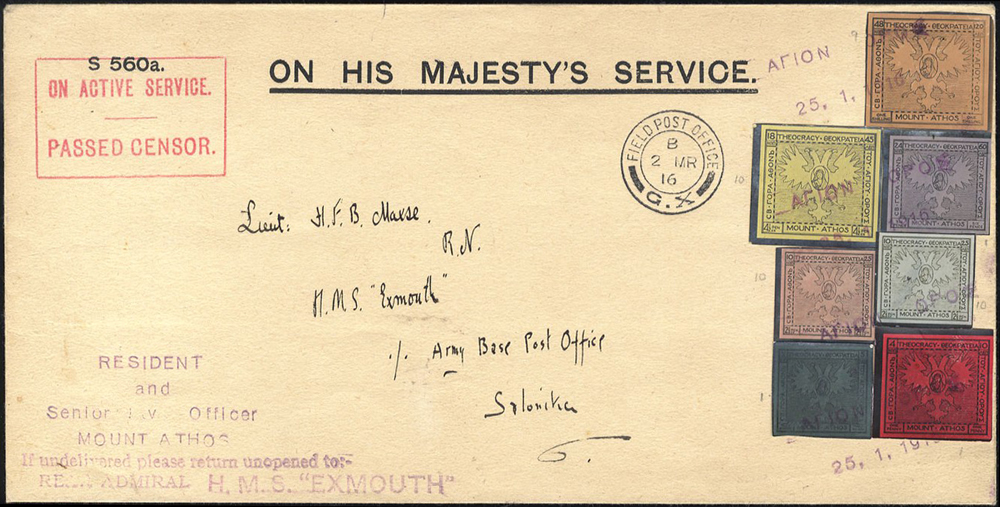
Letter sent to Salonica on 25 January 1916,
arrival postmark of the field office FIELD POST OFFICE 2 MR 16,
red rectangular censor cachet in the upper left corner.
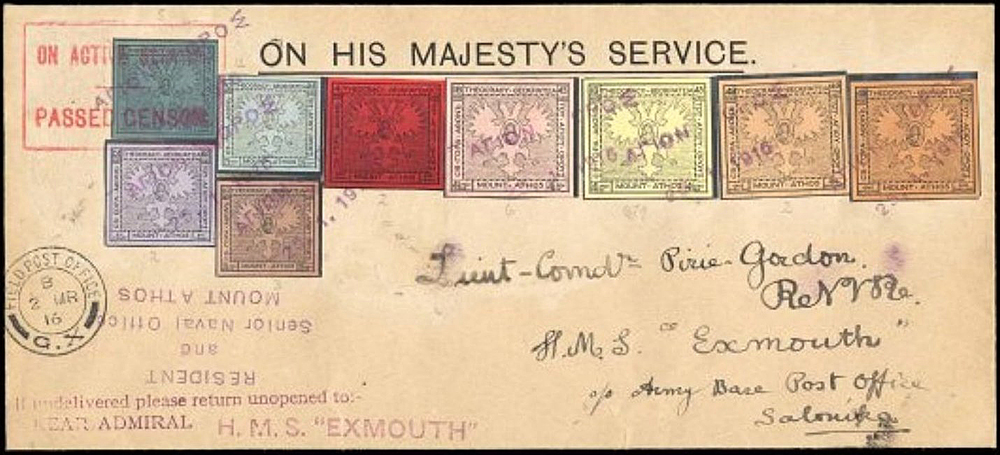
Letter sent to Salonica on 25 January 1916,
arrival postmark of the field office FIELD POST OFFICE 2 MR 16,
red rectangular censor cachet in the upper left corner.
The planned occupation was rejected by Russia, an Entente ally, and never took place. Despite the existence of several philatelic covers that officially passed through the British field post, catalogues classify the stamps as “unissued” (essays). Most of the printing was later destroyed.
During the First World War, Greek Macedonia became a battlefield with thousands of casualties. Greek sovereignty over the territory existed only on paper, and Imperial Russia was interested in granting autonomy to Mount Athos.
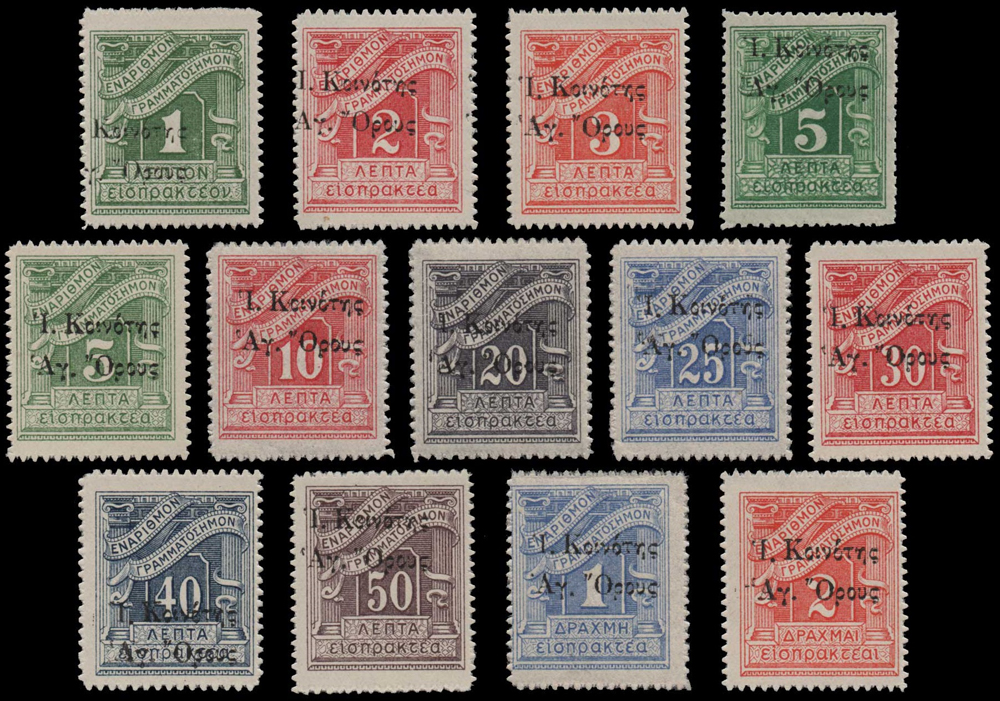
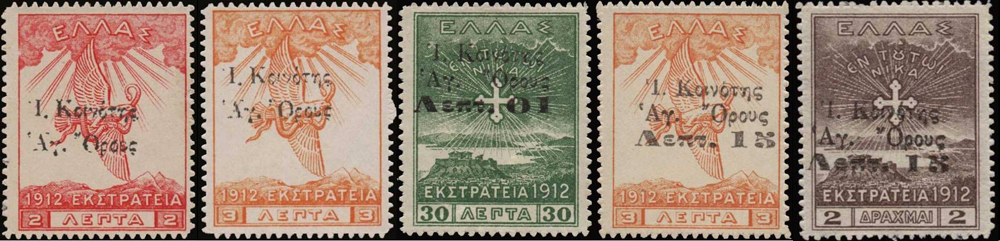
To strengthen its position, the Greek government decided, for diplomatic reasons, to issue an overprinted set in 1916 bearing the inscription “Ι. Κοινότης Αγ. Όρους” (Holy Community of the Holy Mountain). Postage-due stamps, Campaign-series stamps and postal stationery were used for the overprint.
The issued stamps were sent to Salonica but never reached Athos, because Russia had abandoned its interests due to the ongoing revolution and pressure on Greece had eased.
The stamps returned to storage; some were, however, accidentally distributed to several post offices in Greece, where they were used as ordinary stamps. In 1931, almost all of them, except for a small number, were burned.
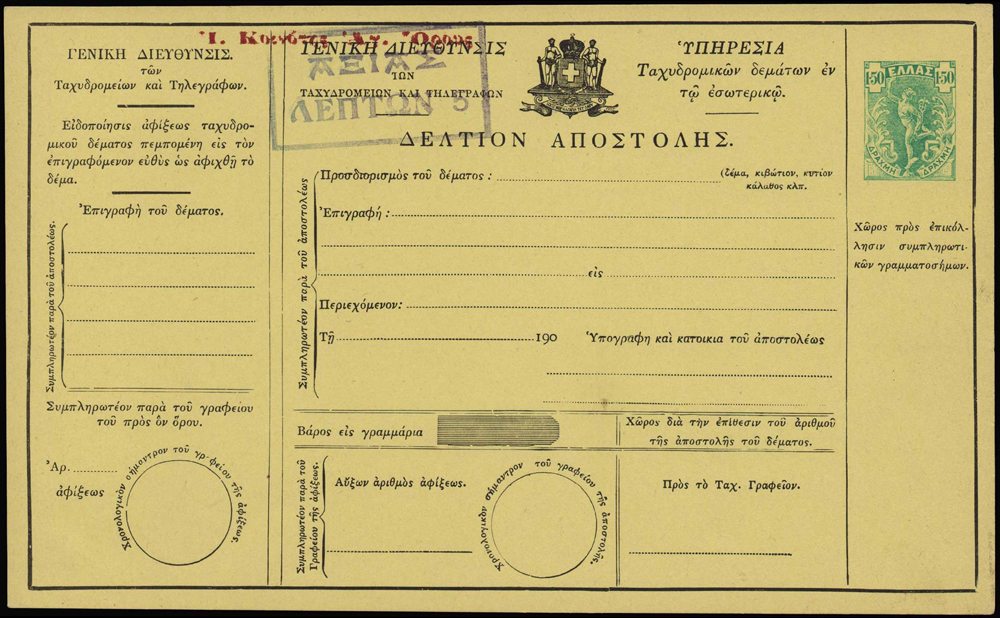
Postal stationery parcel card for domestic transport,
with red overprint at the top Ι. Κοινότης Αγ. Όρους,
violet rectangular cachet ΑΞΙΑΣ (value) ΛΕΠΤΩΗ 5.
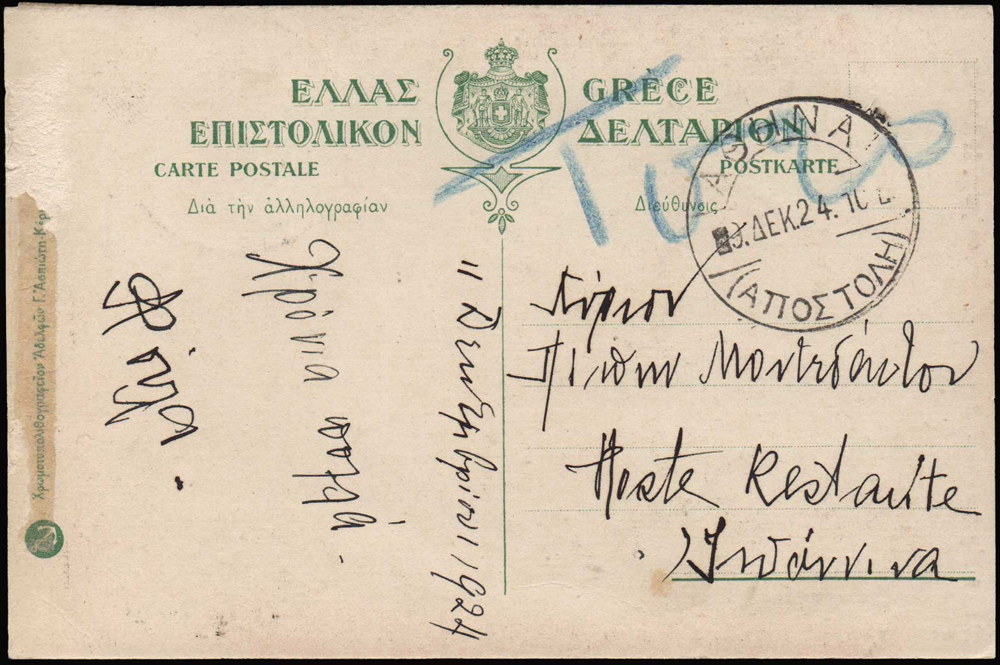
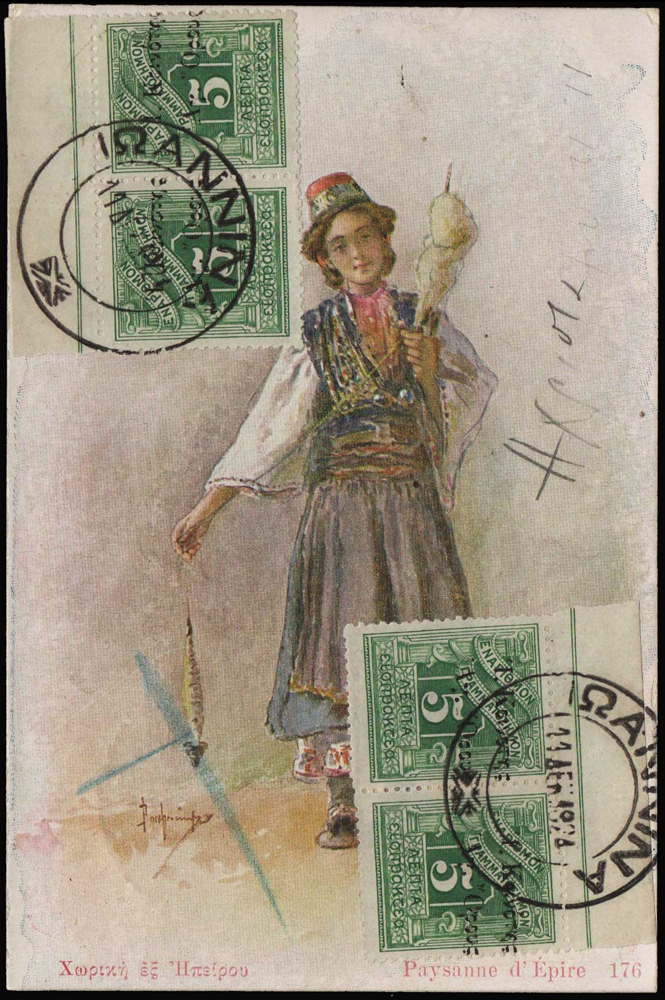
Postcard sent from Athens to Ioannina on 9 December 1924 without prepaid postage,
charged with postage due, which was paid with overprinted postage-due stamps,
with postmark ΙΩΑΝΝΙΝΑ 11 ΔΕΚ 1924.
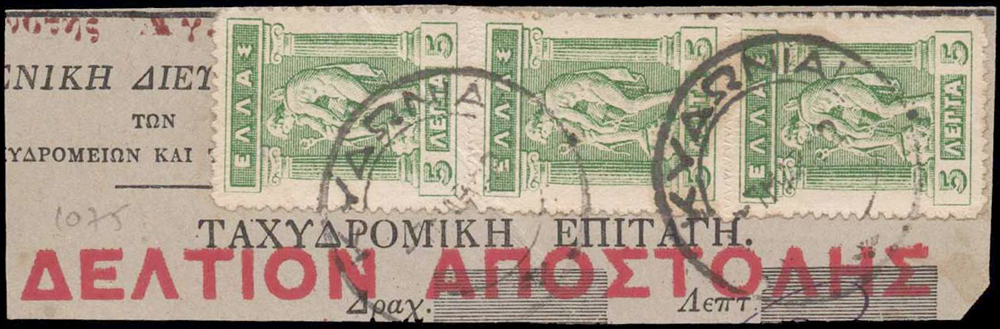
Money-order form, with part of the red overprint Ι. Κοινότης Αγ. Όρους in the upper left corner,
and postmark ΚΥΑΩΝΙΑΙ.
After the end of the First World War and the subsequent Greco-Turkish War (1919–22), the final act of the Lausanne Conference was officially approved on 24 July 1923. It established the definitive border between Greece and the newly formed Republic of Turkey.
Greece used its ordinary stamps in all its territories, including Athos.
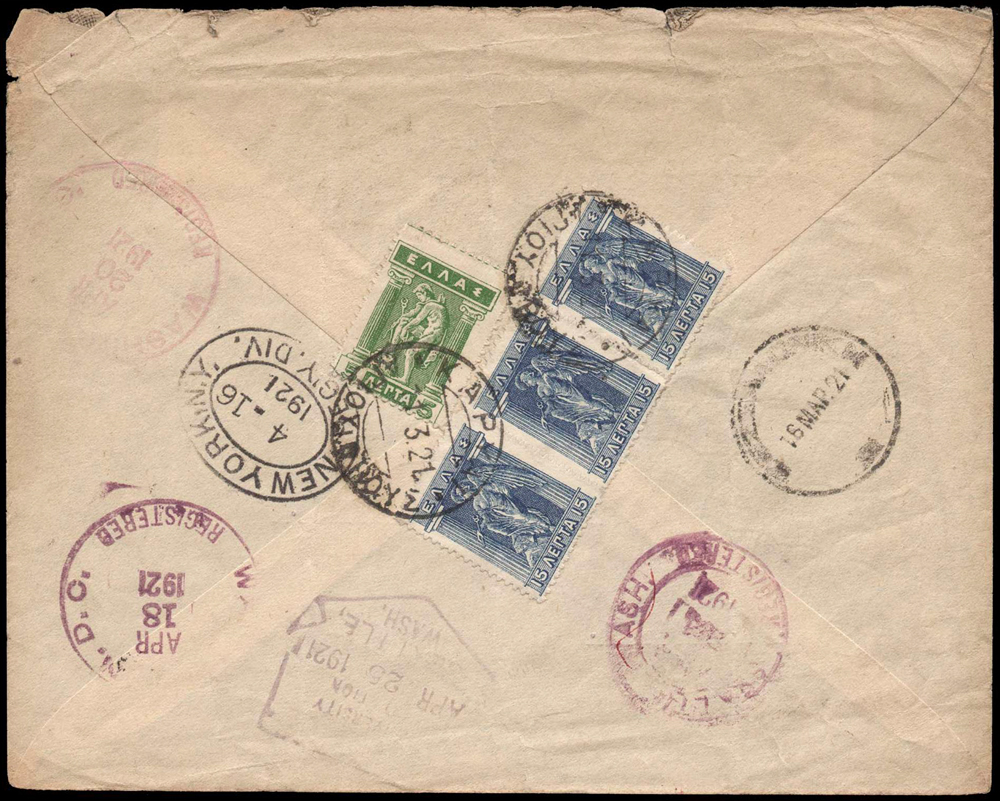
Reverse of a letter sent on 11 March 1921 from Karyes to Seattle, Washington,
transit postmark ΘEΣΣΑΛOΝΙΚΗ 16 MAP. 21,
black oval transit postmark NEW YORK 4. 16 1921,
violet transit postmark WASHINGTON. D. C. APR 18 1921,
violet transit postmark WASHINGTON. D. C. APR 20 1921,
violet transit postmark SEATTLE, WASH. APR 21 1921,
and square violet arrival postmark UNIVERSITY APR 25 1921 SEATTLE, WASH.
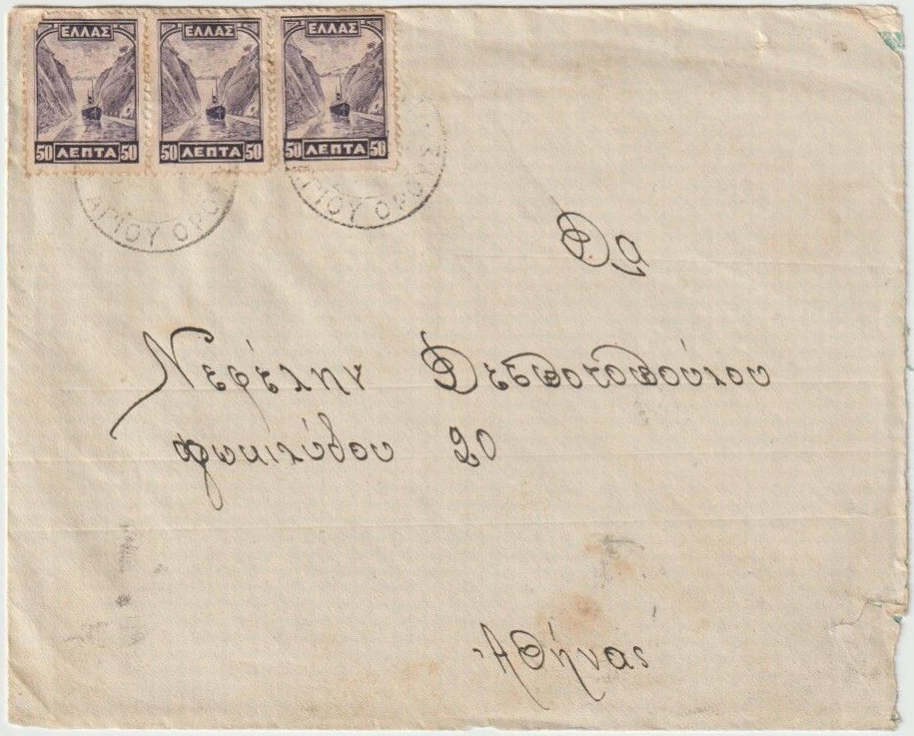
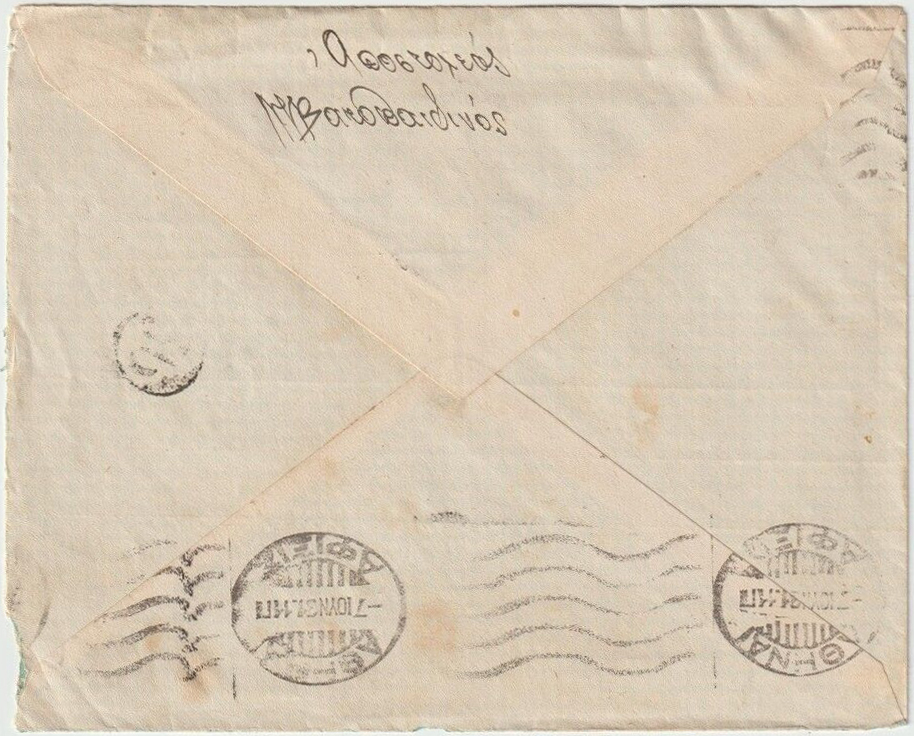
Letter sent on 3 June 1931 from Karyes to Athens,
with machine arrival postmark AΘΗΝΑΙ 7 IOYN 31 AΦΙΞΙΣ on the reverse.
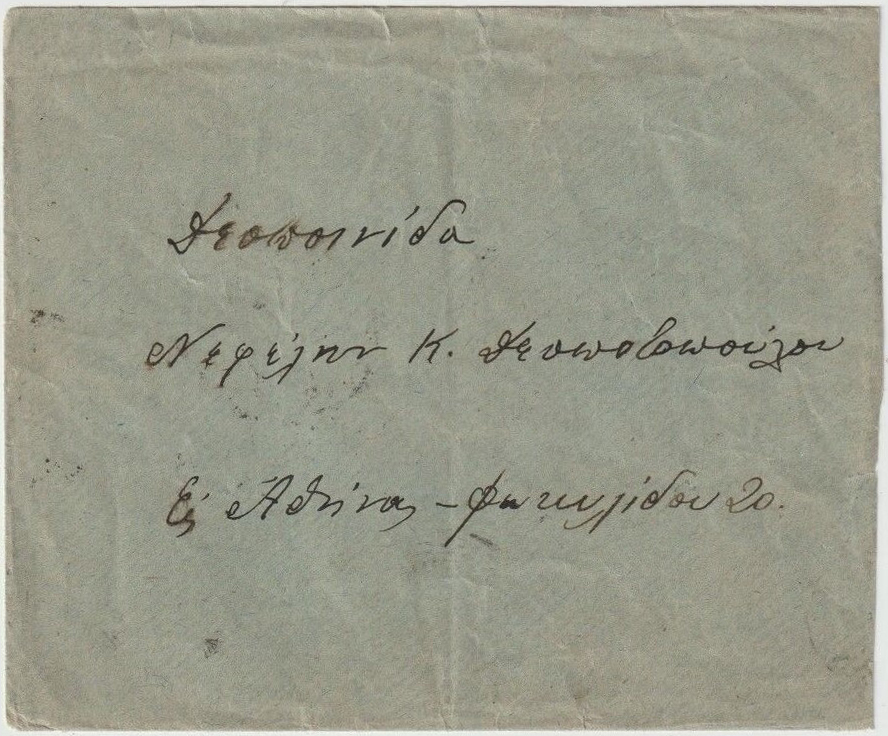
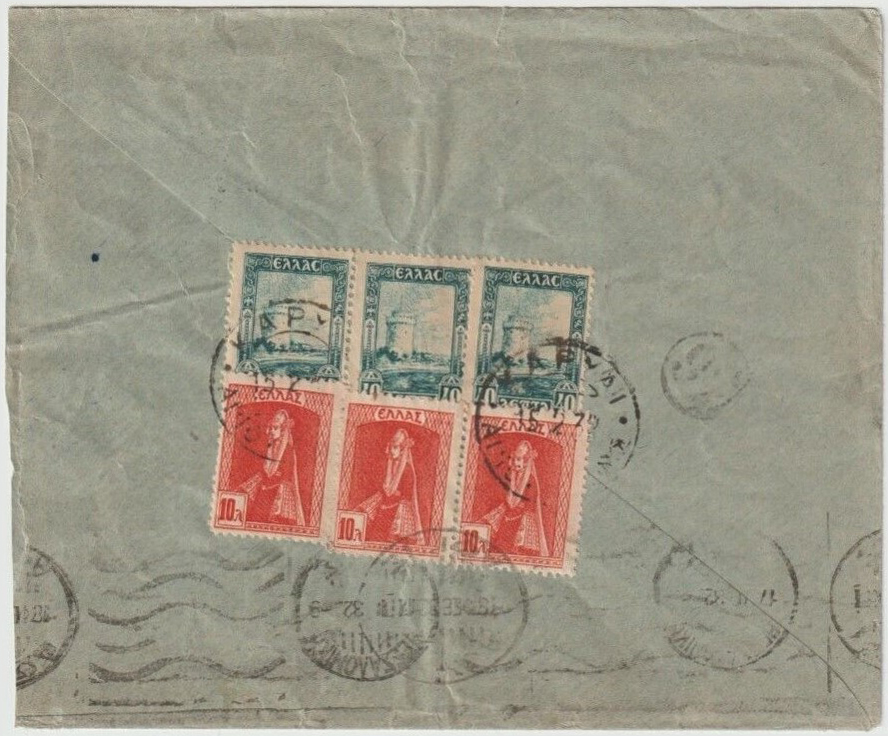
Letter sent on 15 February 1932 from Karyes to Athens,
with machine transit postmark ΘEΣΣΑΛOΝΙΚΗ 17 II. 32 on the reverse
and machine arrival postmark AΘΗΝΑΙ 18 ΦEB 32 AΦΙΞΙΣ.
For the millennium anniversary of the foundation of the first monastery, the Greek administration issued a commemorative stamp set on 5 December 1963 depicting several monasteries and landmarks of Mount Athos.
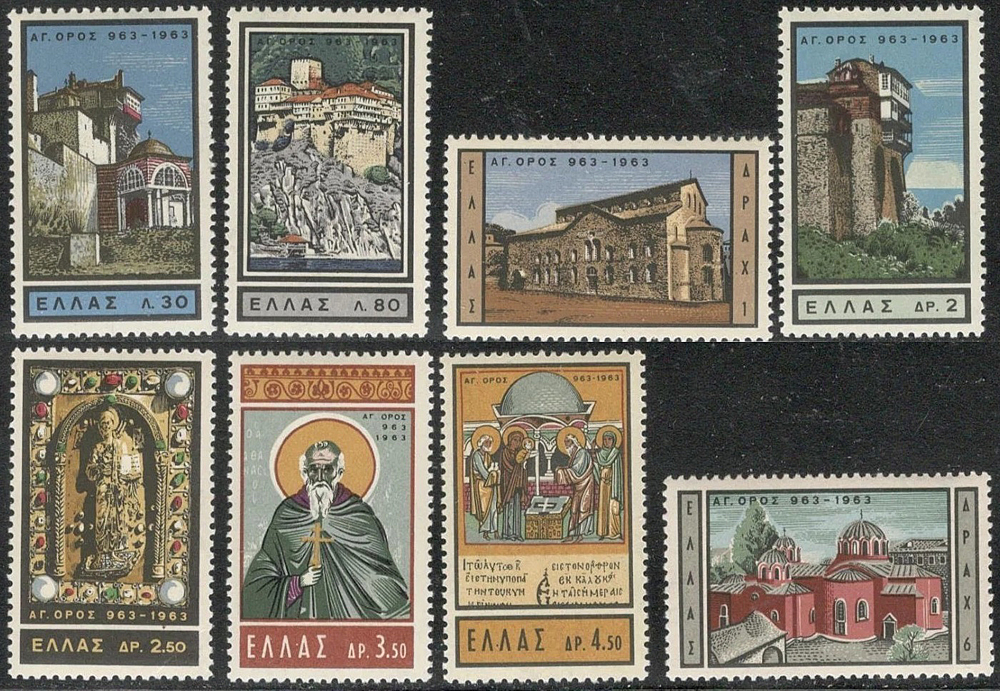
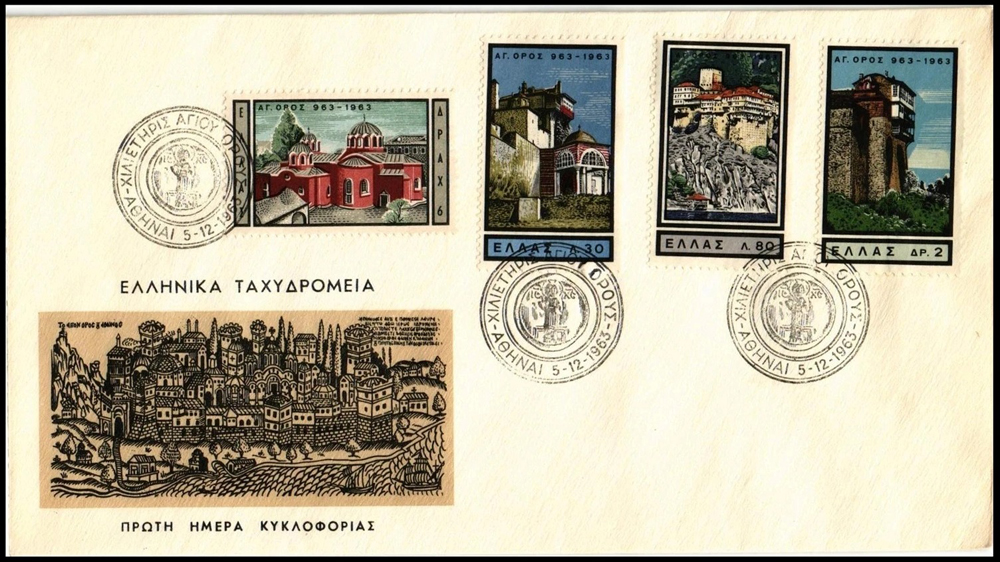
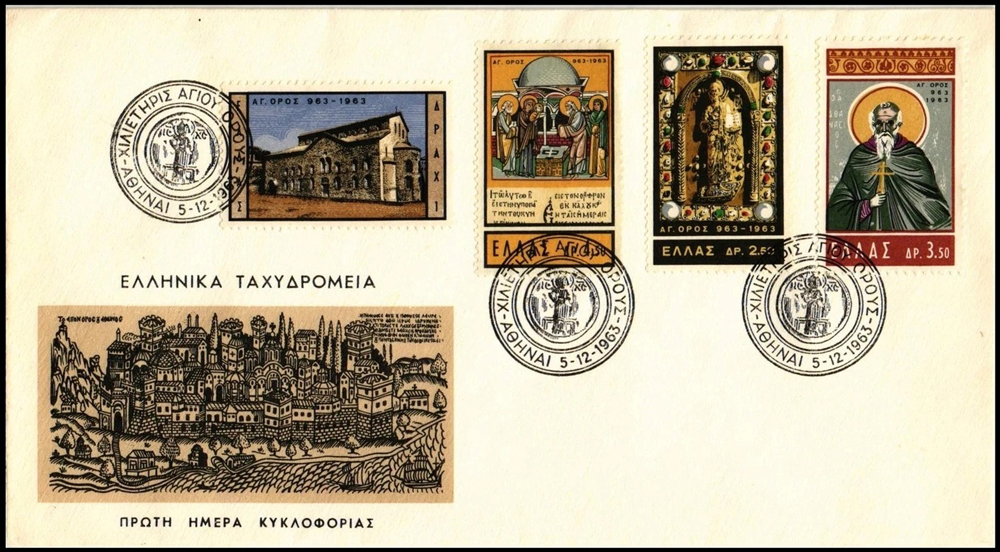
First day covers (FDCs) with the issued stamps.
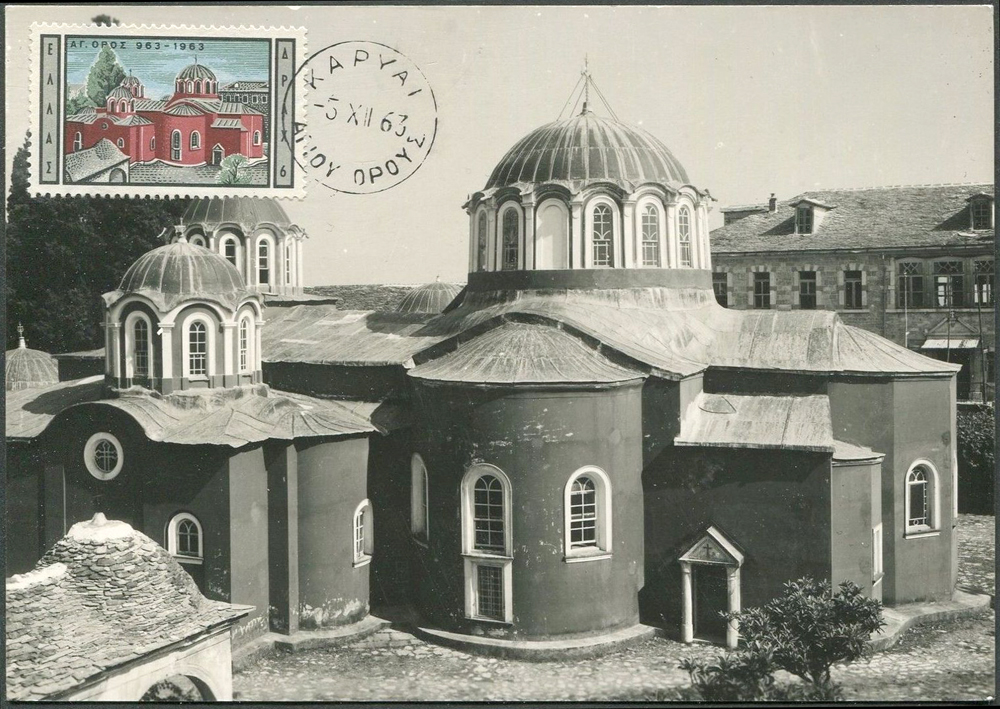
Carte maximum depicting the Megisti Lavra monastery
with postmark ΚΑΡΥΑΙ 5 XII 63 AΓΙΟΥ OΡΟΥΣ.
On 16 May 2008, the Greek administration began issuing definitive postage stamps bearing the text AΓΙΟΝ OPOΣ AΘΩΣ / AGION OROS ATHOC / HELLAS. They were intended for use at the two post offices on Mount Athos, but were valid throughout Greece.
The aim was to raise global awareness of the holy monasteries and their history, architecture and way of life, and to promote the flora, fauna and natural beauty of the region.
The issue of these stamps ended on 8 November 2017.
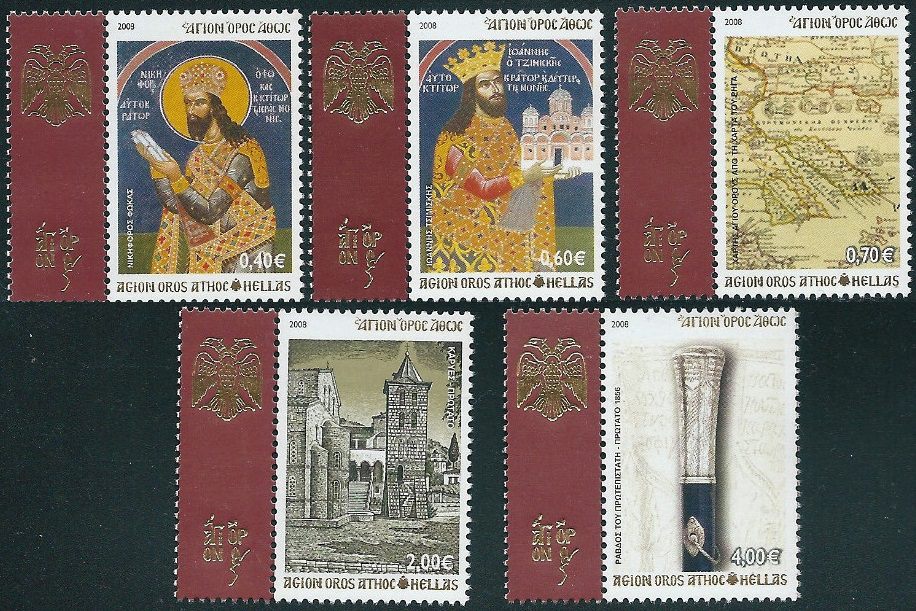
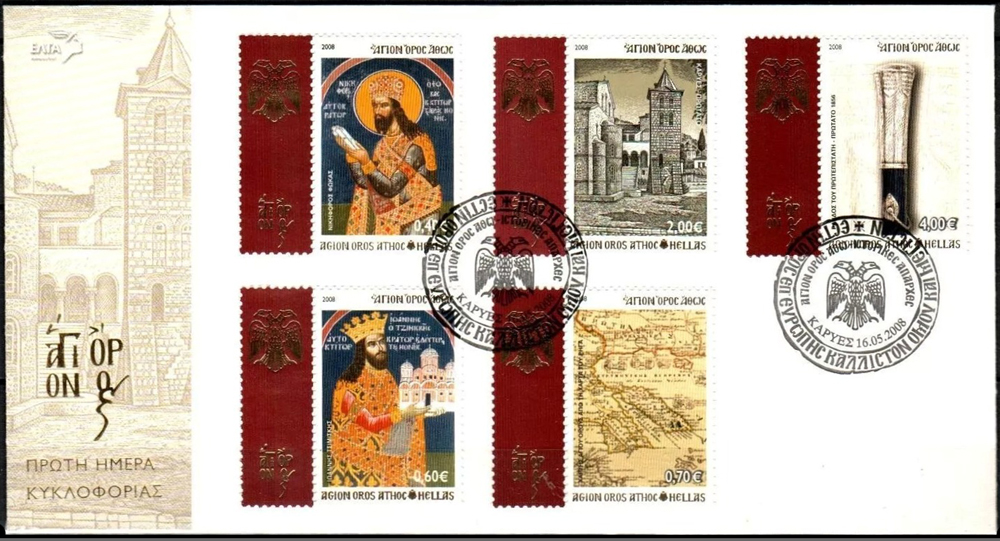
First day cover (FDC) issued on 16 May 2008.
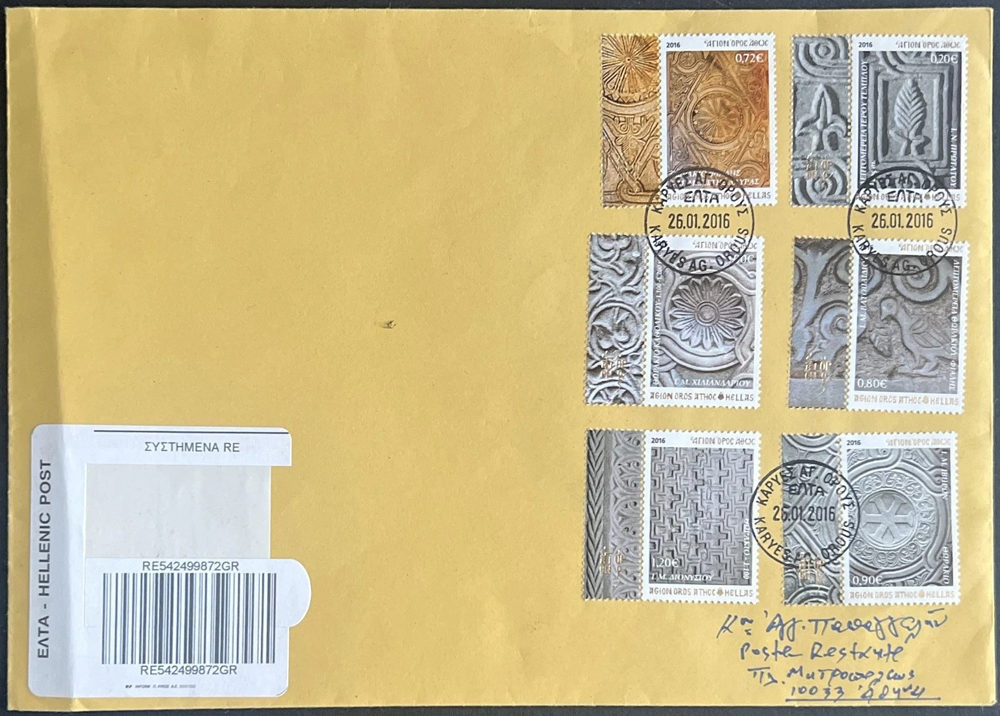
Registered letter sent on 26 January 2016 from Karyes to Athens.
The only way to reach Athos is by sea. The nearest major city is Salonica, where visitors usually begin their journey. From Salonica, you must travel 130 km by car, taxi or bus to the port of Ouranoupolis (Ουρανούπολη). Most visitors board one of the ships departing for the port of Dafni. Along the way, they also call at monasteries along the coast. From Dafni, buses travel to Karyes, from where further buses connect to any of the monasteries.
A visit must be planned well in advance. This is sacred ground dedicated to prayer, meditation and self-knowledge. Pilgrims and visitors are welcome, but their numbers are controlled in order to minimise disturbance of the peace. Each day, entry is permitted for 100 Orthodox Christians and only 15 people of other faiths. The entry process is regulated through the issue of a permit called a “Diamonitirion” (ΔIAMONHTPION). Reservations are made through the Mount Athos Pilgrims’ Bureau in Salonica, while the permit must be collected in person at the Pilgrims’ Office in Ouranoupolis.
Many useful websites can be found online, for example: Diamonitirion: How to Get the Mount Athos Entry Permit (2025 Guide).
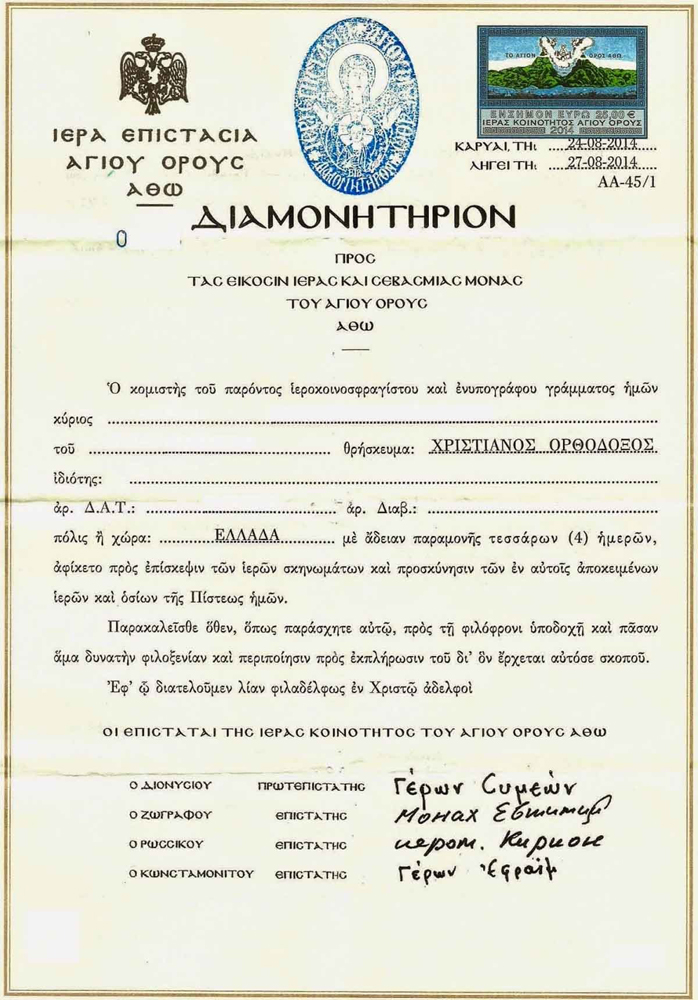
Diamonitirion from 2014.
© Michel-Europa-Katalog: Südosteuropa. Schwaneberger Verlag, 2009/2010.
© Scott Standard Postage Stamp Catalogue. Scott Publishing Co., 2017 (2016 printing)
© A. Karamitsos Catalogue — Hellas (2010). A. Karamitsos Publications, Thessaloniki (Greece), 2010.
© ISFILA. Türk Pullari ve Antiyeleri Katalogu 1863–2006. Isfila, Istanbul, 2007.
© Mascini, J.: Mount Athos — The Holy Mountain (online / brochure). Available from: PVGriekenland (PDF).